
Rubber Ring: vibration reduction in railway vehicles
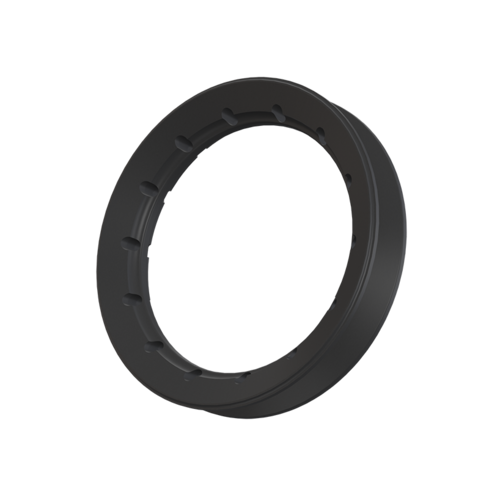
Rubber rings in resilient wheels form the elastic intermediate layer between the tire and the wheel disc, their optimized spring and damping properties ensure effective noise and vibration reduction during vehicle operation.
Area of application
Rubber rings in resilient wheels are primarily used in urban and commuter transit. They help reduce noise, dampen vibrations and minimize wear - for example, in trams, subways and low-floor vehicles. They are also used wherever elastic decoupling between the tire and the wheel body is necessary, such as to reduce un-sprung mass and improve ride comfort.
Technical details
Rubber rings in resilient wheels form an elastic intermediate layer between the wheel tire and the wheel body and are made of an elastomer compound tailored to the specific requirements. They provide defined axial and radial elasticity, structurally decouple the wheel tire from the wheel body and thereby reduce wear on the wheel and rail. At the same time, through design measures, they ensure the necessary current flow during rail operation and are designed for high continuous loads.
Characteristics
Rubber rings in railway vehicle wheels have special properties. These include exceptional temperature resistance, allowing them to maintain their spring and damping properties both in cold conditions and under high braking heat loads. Their resistance to chemicals and aging ensures stable performance despite environmental influences such as moisture or ozone. In addition, the rubber rings exhibit a defined deformation behavior that allows for controlled compression of the tire, thereby improving both ride comfort and tracking stability. Thanks to their high vibration and structure-borne noise absorption, they make a significant contribution to noise reduction in the passenger compartment and the surrounding area. Last but not least, modern rubber ring designs allow for precise tuning of wheel-side stiffness, enabling optimal performance across different vehicle types and usage profiles.