
Aggregate bearing
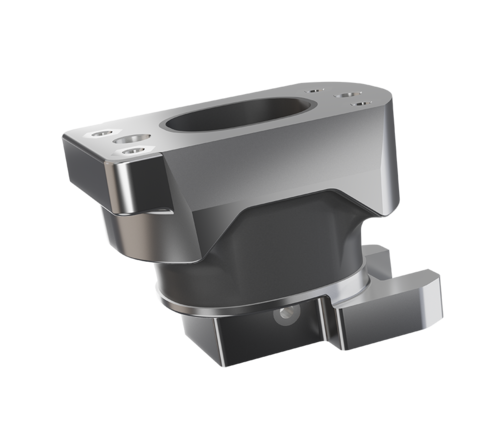
Rubber-to-metal bonded aggregate bearings are used in the car bodies of railway vehicles to elastically connect drive components, auxiliary units or superstructures to the vehicle frame. These mounting elements are available in various versions and are installed both on and under the car body as well as inside it.
Area of application
Rubber-to-metal bonded aggregate bearings operate under high dynamic and acoustic loads in railway vehicles and must reliably dampen and compensate for vibrations, shocks, and temperature fluctuations. They are used wherever power units must be elastically mounted to the car body - such as compressors, air conditioning systems, fans, battery boxes, inverters or transformers that are mounted on the underfloor frame or in the roof or interior. Since these components are often located in confined installation spaces and are subjected to varying load conditions while the train is in motion, the mountings must safely accommodate misalignment, multi-axial loads and installation tolerances while simultaneously ensuring a stable, vibration-decoupled connection to the car body.
Technical details
Aggregate bearings consist of firmly vulcanized elastomer between metal parts, thereby providing a damping, vibration-isolating mounting that effectively reduces both vibrations and structure-borne noise. These mounts also compensate for tolerances, misalignment and dynamic loads and prevent hard impacts or resonances from being transmitted directly into the car body.
Characteristics
Thanks to their flexible yet robust design, rubber-to-metal bonded aggregate bearings help reduce wear, ensure smoother operation and provide a durable mounting for the units - even under demanding operating conditions such as varying loads, temperature cycles, or track irregularities.
Components
Wedge Bearing
In railway vehicles, a rubber-to-metal bonded wedge bearing serves as an elastic mount for power units and suspension systems in interior and underfloor areas. Through the combination of form-fitting metal parts and a specially designed elastomer body, it effectively dampens vibrations and shocks, thereby reducing the transmission of structure-borne noise to the car body. The wedge-shaped geometry enables a high load-carrying capacity with a compact design and ensures stable, defined force transmission. As a component mount - for example, for air conditioning units, compressors, or inverters - it protects the assemblies from dynamic loads, thereby improving their service life and smooth operation. When used as a suspension element, it compensates for relative movements caused by track irregularities, braking forces or cornering, thereby relieving stress on the frame and suspension structures. Its robust construction, high fatigue strength and weather resistance make the rubber-metal wedge bearing ideal for long-term use in demanding railway applications.
Conical mounting
A rubber-metal conical mounting is used in railway vehicles to provide flexible mounting for roof-mounted units such as air conditioning units, fans or inverters. Thanks to its conical elastomer body with an integrated metal core, it reliably dampens vibrations and reduces the transmission of structure-borne noise to the car body. The geometry provides defined axial and radial stiffness, allowing the bearing to respond softly to small vibrations while stably absorbing forces under higher loads. This protects both the roof-mounted units and the vehicle structure from peak loads. During operation, the conical bearing compensates for relative movements caused by driving dynamics, track irregularities, or wind loads, while simultaneously extending the service life of the mounted components. Thanks to its robust construction and weather resistance, it is ideally suited for outdoor use on railway vehicles.