
Protective front guard
Rubber and metal protective front guards or fenders are used in defence technology and military industry as flexible track covers to protect against dirt, shrapnel and gunfire, as well as to prevent damage to surrounding objects. Front guards provide mechanical protection and withstand heavy loads and external impacts. They enhance the protection of track assemblies and contribute to the operational reliability and durability of military and defence vehicles.
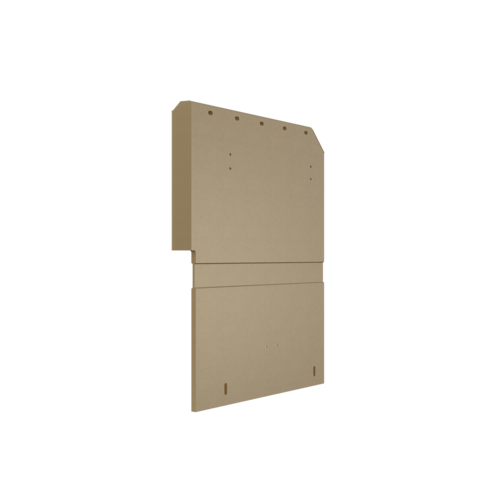
Area of application
Rubber and metal protective front guards or fenders are used in defence and military engineering, primarily on tracked vehicles such as armored personnel carriers, armored transport vehicles and engineer vehicles, to deflect dirt, mud, water and loose debris during off-road and urban operations, as well as to dampen noise and vibration transmission. They are particularly well-suited for operations involving frequently changing terrain. Front guards are used where increased protection against rock impacts, shrapnel, mine remnants or heavy mechanical stresses is required, such as on main battle tanks or heavy support vehicles. They protect the track assembly, adjacent components and following vehicles, thereby increasing operational reliability and system service life.
Technical details
Rubber and metal front guards or fenders are typically made of highly abrasion-resistant elastomers; they often have a multilayer construction and are locally reinforced with textile or steel mesh inserts or steel plates to increase tear resistance, resilience and temperature resistance. They are mounted using a modular system, mounted on vibration-isolated bearings and designed to counteract the effects of the ground, water and flying debris. Their construction is rigid or segmented, frequently bolted or welded and designed for maximum structural stability as well as resistance to abrasion, heat and mechanical impacts.
Characteristics
Rubber and metal front guards or skirts are characterized by high flexibility, strong energy absorption, noise and vibration damping and resistance to abrasion, moisture and chemicals. They are largely resistant to damage and effectively reduce the ingress of dirt and debris into the track area. Front skirts offer high structural strength, resistance to extreme mechanical stresses, heat and shrapnel impact, as well as a long service life under combat and heavy-duty conditions. They enhance the protection of the track system, system reliability and the operational capability of vehicles in demanding defense and military technology environments.