
Traction Rod in bogies
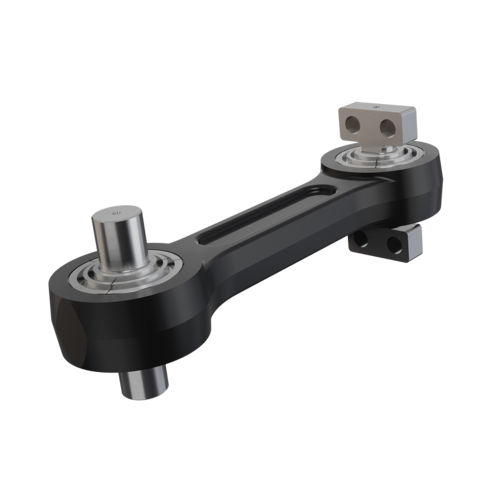
In bogies, traction rods perform the primary function of guiding the wheels in the direction of the ride, absorbing longitudinal forces such as braking and traction forces. They keep the axle or wheel carrier stable and guide it in a nearly vertical direction, while additional components must absorb lateral forces. Linkage rods, on the other hand, primarily serve to transmit forces and motion between various components of the bogie. They function as kinematic connecting elements, stabilize motion sequences and help fine-tune vehicle dynamics without themselves assuming the primary role of wheel guidance.
Area of application
In the railway vehicle sector, longitudinal rods in bogies are used to provide stable guidance for axles or wheel carriers in the direction of the ride, as well as to safely transfer longitudinal forces and braking torques to the vehicle frame. Linkage rods act as kinematic connecting elements for force transmission and motion control and help coordinate lateral and longitudinal movements, thereby contributing to vehicle dynamics and a smooth ride. These links are used in nearly all railway vehicles equipped with bogies. They are particularly common in trams and light rail vehicles, where they guide the wheel sets in low-floor bogies. They also ensure precise force transmission and stable handling in subways, metros, regional and commuter trains, as well as in passenger coaches and multiple-unit trains. In freight cars and locomotives, they also ensure the reliable absorption of high longitudinal and lateral forces.
Technical details
These control arms - which may be designed as longitudinal rod, link rods, push-pull rods, traction control arms or torque struts - consist of a bar-shaped member made of cast steel, a forged piece, or welded steel. At both ends are rubber-metal bearings - usually referred to as spherical bearings or ball joints - which are attached to the wheel set bearing housing and the bogie frame. These elastic mounts transmit forces in the longitudinal direction while simultaneously damping vibrations and small relative movements. Longitudinal control arms are arranged on both sides of a wheel set and are generally oriented diagonally forward or backward in the direction of travel. Two traction rods are typically used per wheel set to ensure stable and symmetrical guidance.
Characteristics
These guide mechanisms ensure precise track alignment, even on tight curves, and provide a smooth ride even at higher speeds. The controlled guidance and elastic bearings effectively reduce dynamic forces, which enhances both ride comfort and stability. In addition, the reduced stress leads to less wear on the wheel and rail. Thanks to their simple, robust design, these steering arms are easy to maintain and durable. They can be refurbished by replacing components such as the ball joints.