
Damping Element
Damping elements are used in mechanical and plant engineering, as well as in industrial technology, as mounting elements to reduce vibrations, shocks and structure-borne noise. They protect machines, systems, and assemblies from dynamic loads and increase service life, operational reliability and precision. Typical applications include the elastic mounting of machines, power units, foundations, scales and sensitive industrial equipment.
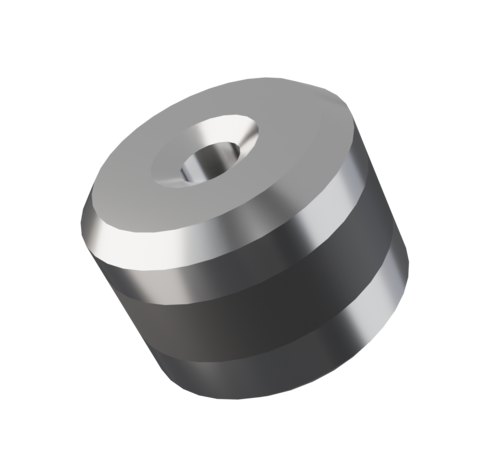
Area of application
Damping elements are used in mechanical and plant engineering for vibration- and shock-isolating mountings of machines, units and assemblies. Key areas of application include motor, gearbox, pump and compressor mountings, where they help minimize dynamic loads and noise transmission. In industrial engineering, they are used in precision machines, test benches, scales and manufacturing systems where smooth operation is essential. In addition, damping elements are used for foundation decoupling to prevent vibrations from being transmitted to buildings or steel structures. They are primarily used in applications where the focus is on reducing wear, ensuring process stability and maintaining operational safety.
Technical details
Damping elements used as bearing elements are engineered with defined spring stiffnesses and material-dependent damping coefficients to specifically convert energy and reduce vibrations. Depending on the design, they consist of elastomers, metal components or combined materials that are tailored to specific load and frequency ranges. Typical characteristics include axial and radial load-bearing capacity and in some cases, the ability to absorb tilting and lateral forces. Many damping elements have progressive or nonlinear characteristic curves to reliably control both small vibrations and high impact loads. In addition, they are designed for continuous dynamic loading, temperature resistance and maintenance-free operation.
Characteristics
Damping elements used as bearing elements have defined spring and damping characteristics that are specifically designed to reduce vibrations and shocks. They offer axial, radial and, in some cases, torsional load-bearing capacity and adapt to dynamic load cycles. They typically feature nonlinear characteristic curves that ensure increased stiffness and safety as the load increases. Depending on the design, they enable the compensation of misalignment, angular errors and movements. In addition, damping elements are characterized by maintenance-free operation, a long service life and application-specific material selection.