
Coupling Elements
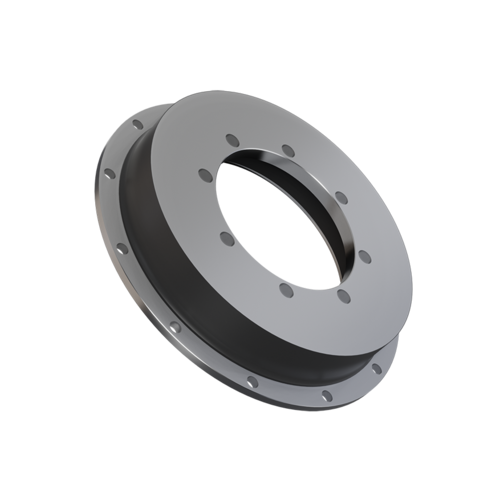
Coupling elements are elastic connecting elements that couple two mechanical components together while simultaneously reducing vibrations, shocks and dynamic loads. They combine a dimensionally stable metal carrier with an elastic rubber element, thereby integrating power transmission and damping into a single component. In applications involving rotational motion - such as in rotary couplings - they ensure precise motion compensation as well as smooth, stable force transmission.
Area of application
Rubber-to-metal bonded coupling elements are used in numerous industrial applications where different components need to be connected while minimizing vibrations. Typical applications include mechanical and plant engineering, drive systems, pumps, compressors, conveyor systems and power units. They compensate for misalignment, radial and axial movements and enable smooth power transmission between the drive and the driven component.
Technical details
Rubber-to-metal bonded coupling elements consist of one or more metal end pieces connected to each other via a vulcanized elastomer body. The rubber element is designed with specific hardness levels, material compositions and spring characteristics to effectively dampen vibrations while ensuring reliable power transmission. Depending on the design, it can absorb and compensate for axial and radial forces as well as torsional moments. The metal components provide structural stability and secure the assembly within the drive system, while the elastomer absorbs load peaks and elastically compensates for movements. Depending on the requirements, variants with oil-resistant, temperature-resistant or abrasion-resistant rubber compounds are used.
Characteristics
Rubber-to-metal bonded coupling elements are characterized by their elasticity and robust construction. They reduce noise and provide vibration isolation, improve the smooth operation of drive systems and protect adjacent components from mechanical overload. Their elastomeric elements enable flexible power transmission and compensate for manufacturing or assembly tolerances. At the same time, the metal end pieces offer high dimensional stability and resistance to dynamic forces. The couplings are low-maintenance, durable and continue to function reliably even under varying loads, making them particularly suitable for continuous industrial applications.