
Reinforced Bridge Bearing
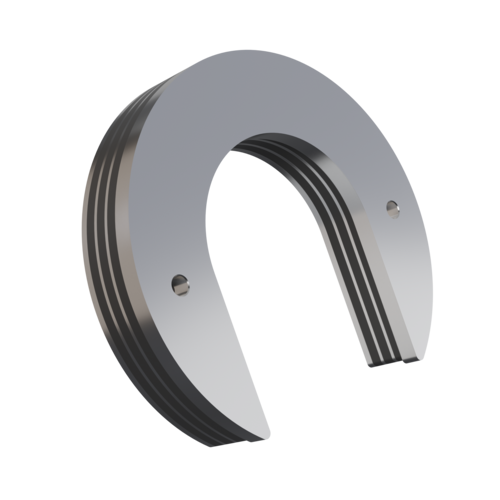
Reinforced bridge bearings are elastomeric bearings with embedded and vulcanized steel plates or fabric inserts. This reinforcement increases their load-bearing capacity, dimensional stability and durability. They reliably transmit vertical and horizontal forces and allow for controlled displacement and rotation.
Area of application
Reinforced bridge bearings are primarily used in heavily loaded road and rail bridges, overpasses, viaducts and structures subject to high vertical and horizontal loads. They are particularly suitable for applications requiring high load-bearing capacity, high dimensional stability and reliable movement absorption.
Technical details
Reinforced bridge bearings consist of elastic rubber layers reinforced with embedded steel plates or fabric inserts. This reinforcement increases the load-bearing capacity, prevents uncontrolled deformation and ensures stable, long-term load transfer. The bearing can absorb vertical loads, limit horizontal forces and safely accommodate movements such as displacement and rotation without overloading the structure.
Characteristics
Rubber-metal reinforced bridge bearings are low-maintenance support elements made of vulcanized elastomer and steel plates. They transmit high vertical loads, allow for displacement and rotation of the superstructure and simultaneously reduce vibrations and stress peaks. Due to their simple design, high durability and cost-effectiveness, they are among the most commonly used types of bearings in modern bridge construction.