
Gearbox bearing
Gearbox bearings - whether designed as spring elements or as components specifically engineered for their intended application - are used to provide flexible, vibration-isolated mounting for gearbox units. Through the combination of elastic materials and stable metallic structural elements, they can selectively allow movement, reduce vibrations and transfer forces in a controlled manner to the surrounding structure.
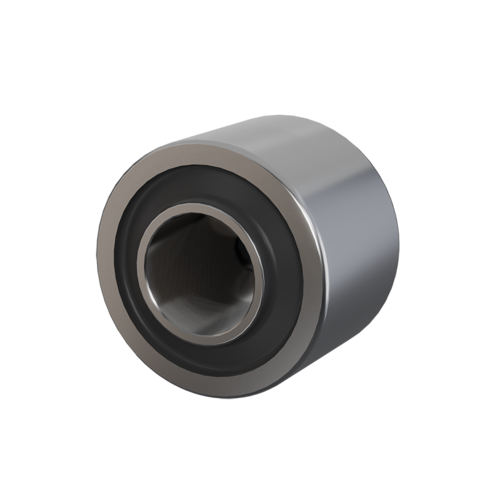
Area of application
Gearbox bearings with suspension properties are used in technical systems where gearboxes must be mounted to minimize vibration and mechanically decoupled. They are found in machine drives, in conveyor and production technology, in mobile drive units and in systems supported by power units that are subject to dynamic loads. Thanks to their elastic design, they protect adjacent components from shocks, structure-borne noise and load spikes. They contribute to smooth and quiet gear operation. Specially engineered solutions are used when specific installation conditions, high load cycles or defined travel ranges must be taken into account.
Technical details
The transmission mounts consist of a sturdy metal support or housing component that serves as a mounting or attachment point as well as an integrated elastic element made of rubber or comparable elastomers. The elastomer is firmly bonded to the metal component and possesses defined spring and damping characteristics. By selecting the appropriate material composition, elastomer hardness and geometry, the mount can be precisely tailored to the required load and motion parameters. Depending on the design, radial and axial forces as well as torsional moments can be absorbed and balanced.
Characteristics
Rubber-and-metal transmission or gearbox bearings are characterized by excellent vibration damping, good elasticity and high structural stability. The elastic components reduce vibrations and noise, while the metal components ensure reliable power transmission and dimensional stability. The mount allows for controlled elastic movement, protects adjacent components and contributes to quiet, efficient and long-lasting operation of the drive system. Thanks to their robust design, these components are largely low-maintenance, wear-resistant and designed for dynamic load cycles. Specially developed variants offer additional options for adapting to specific operating conditions or design requirements.