
Torque support: key component in bogies
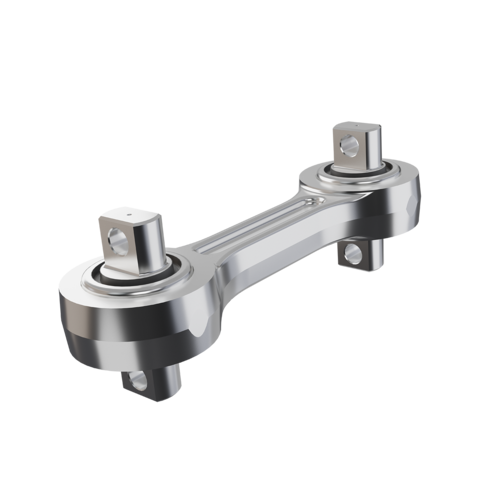
Torque supports are key components in the powered bogies of rail vehicles. They serve to connect the transmission housing to the bogie frame while absorbing the reaction forces from drive and braking torques generated in the wheel-set gearbox. Thanks to their rod-shaped, force-transmitting design, they prevent these torques from being transmitted uncontrollably into the vehicle frame, thereby contributing to stable power transmission and reliable operation of the powertrain.
Area of application
Torque supports are used in railway vehicles whenever powered bogies are employed and the drive and braking torque generated by the transmission must be reliably supported. They are particularly common in locomotive-type vehicles, multiple-unit trains and subways, since in these cases the wheel-set gearbox is directly connected to the traction motor and the resulting reaction forces must be transferred to the bogie frame. They connect the gearbox housing to the bogie frame and prevent the gearbox from rotating or shifting uncontrollably under load. In doing so, they stabilize the entire drivetrain, reduce vibrations and ensure precise power transmission during operation.
Technical details
Torque supports in bogies are connecting elements that couple the transmission housing to the bogie frame, thereby absorbing the reaction forces generated during operation by drive and braking torques. They feature bearing heads with bolt sockets at both ends, often designed as spherical bearings or ball joints, to allow relative movement between the transmission and the frame while precisely transmitting transverse and longitudinal forces. In railway vehicles with powered bogies, such as multiple-unit trains or locomotives, the torque support serves to reliably transmit the torque from the traction motor to the frame via the gearbox. It is designed to continuously absorb high dynamic loads, vibrations and varying operating conditions.
Characteristics
Torque supports in bogies perform other important functions in addition to providing force support. They are designed to reduce vibrations from the drivetrain and prevent critical resonances. Their shape ensures that forces are transmitted as axially as possible, which reduces stress on components such as bearings and gearboxes, and extends their service life. They allow for small movements within the bearing, prevent jerky behavior (stick-slip), and thus improve handling at low speeds. In addition, they compensate for changes in length caused by heat or frame movements without generating additional stress. During frequent load changes, they ensure precise and rapid force transmission. Elastic elements such as ball joints or spherical bearings compensate for movements and angular misalignments between components. They reduce stresses and help dampen vibrations while evenly distributing forces throughout the structure.