
Roller rubber spring: stability for railway vehicles
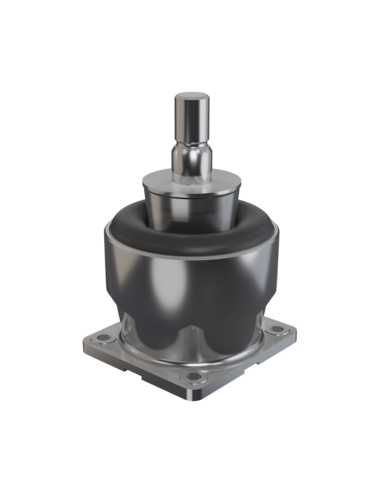
Roller rubber springs are used in railway vehicles as primary springs. The primary spring system acts between the wheel set and the bogie, ensuring stable handling at different speeds and along varying track alignments. The roller rubber spring allows for variable adjustment of the spring characteristic curve by designing the rolling surface of the mandrel and housing. Furthermore, the roller rubber spring offers the advantage of being reconditioned by replacing the ring and repainting the housing.
Area of application
The roller rubber spring serves as the primary spring in the bogie of railway vehicles and provides elastic decoupling between the wheel set and the frame. It dampens track irregularities, reduces vibrations and improves ride comfort. Thanks to its compact design, it is ideally suited for streetcars, subways, regional trains and light railway vehicles. The rolling spring offers long spring travel in a small installation space, is maintenance-free and boasts a long service life—a proven primary spring system for railway vehicles.
Technical details
At its core, a roller rubber spring consists of an inner cylinder, an outer sleeve and a vulcanized rubber ring between the two structural elements. This combination results in a compact, robust and effective primary spring for railway vehicles. Because the spring characteristic curve can be individually tailored to the requirements of the railway vehicle’s bogie and the track, roller rubber springs are highly versatile when used as primary springs in bogies. A roller rubber spring used as a primary spring in a bogie serves to support the vertical loads of the railway vehicle and to absorb shocks and vibrations. Its special design ensures reliable suspension and damping, making the system robust and durable.
Characteristics
Roller rubber springs are maintenance-free, making it easier to maintain railway vehicles. If the primary springs need to be replaced as part of a train overhaul, the components can be reconditioned. To do this, after careful cleaning and inspection, the rubber ring is replaced and the coil springs are repainted. This ensures uniform suspension and thus greater ride comfort. At the same time, it reduces vibrations, minimizes wear and extends the service life of the vehicle components. It also contributes to the overall stability and safety of the vehicle. The roller rubber spring is used as a primary spring in railway vehicles wherever compact design, high vertical travel, low maintenance, reliable force transmission and good ride comfort are required. It is thus a proven spring system in urban transit, regional trains and light rail vehicles.