
Gearbox Mount
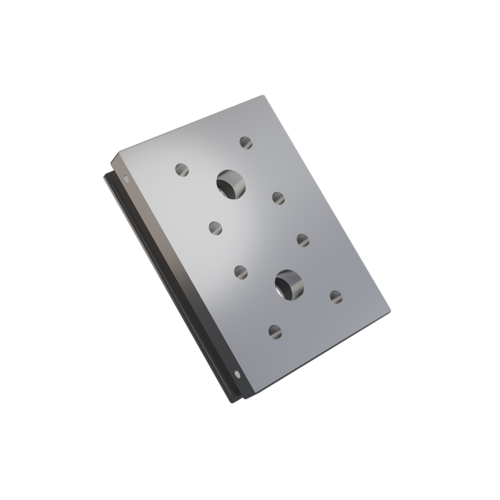
Rubber-and-metal gearbox mounts are used in defense and protection technology to reliably support gear units while decoupling vibrations and dynamic loads. They protect power transmission systems from shock loads and reduce the transmission of noise and vibrations to adjacent structures. As a result, they enhance the operational reliability, precision and service life of drive and transmission systems under demanding operating conditions.
Area of application
Rubber-and-metal gearbox or transmission mounts are used in military wheeled and tracked vehicles to support transfer cases, gearboxes and auxiliary transmissions. They are also used in maritime systems to support transmissions in onboard power units, powertrains and auxiliary machinery. Furthermore they are installed in stationary and mobile systems - such as generators, pumps and weapon system drives - to de-couple the gearbox. In addition, they are used in protected industrial and logistics systems within defense infrastructure.
Technical details
Rubber-and-metal gearbox mounts consist of load-bearing inner and outer metal components that are permanently bonded by a vulcanized elastomer body. The elastomer component is designed to primarily absorb compressive and shear forces from the gearbox and to allow for defined relative movements. Depending on the load condition, the mounts feature integrated stops, multi-part metal cores or radially or axially stepped rubber contours for targeted force transmission. For applications in security and defense technology, materials, processes and tolerances are precisely tailored to high torques, varying loads and military installation specifications.
Characteristics
Gearbox mounts for defense and military applications are designed for precise power transmission with minimal impact on gearbox accuracy and shift quality. They help reduce the structural signature by specifically limiting the transmission of gearbox-induced vibrations into vehicle or system structures.Many designs are low-maintenance or maintenance-free and allow for quick replacement even under operational conditions. In addition, they are often customized for specific variants to accommodate different mission profiles, load combinations and installation conditions within the same platforms.