
Conventional Secondary Spring System
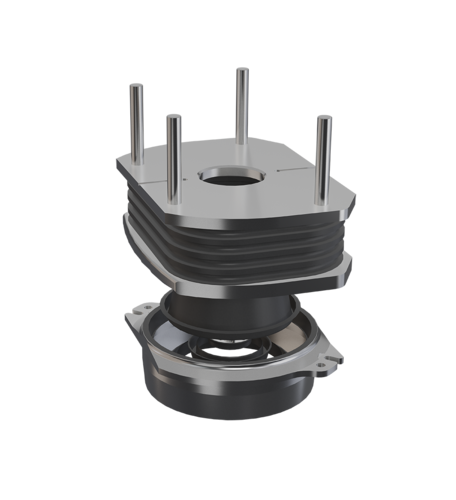
A conventional secondary spring system without an air spring relies entirely on mechanical and elastomeric spring and damping elements; for example, it consists of a combination of a layer spring and a conical spring.
Area of application
Conventional secondary spring systems consisting of conical and laminated springs are ideal for vehicles that require compact spring assemblies, high fatigue strength, low maintenance costs and integrated damping. Thanks to their elastomeric properties, they can combine suspension, damping, and, in some cases, lateral guidance in a single component, making them suitable for confined installation spaces.
Technical details
In conventional secondary spring systems, conical and layer springs provide vertical support for the car body, generating the required spring characteristic curve and bearing both static and dynamic loads. Lateral forces and guidance functions are absorbed by elastomeric transverse guidance or support elements, which also provide some damping. stops and limiting elements protect the system from overload.
Characteristics
A conventional secondary spring system consisting of conical and layer springs is characterized by a robust, proven design and a high level of operational reliability. The vertical spring action is primarily provided by conical springs. Layer springs complement the system by balancing lateral and longitudinal forces while also providing additional material damping. This functional division allows the stiffnesses in the various directions to be specifically tuned, resulting in good ride comfort and stable handling. The system is independent of compressed air, comparatively cost-effective, low-maintenance and particularly well-suited for vehicles that require a simple, durable and robust secondary suspension system.