
Spherical Bearing for drive systems in railway vehicles
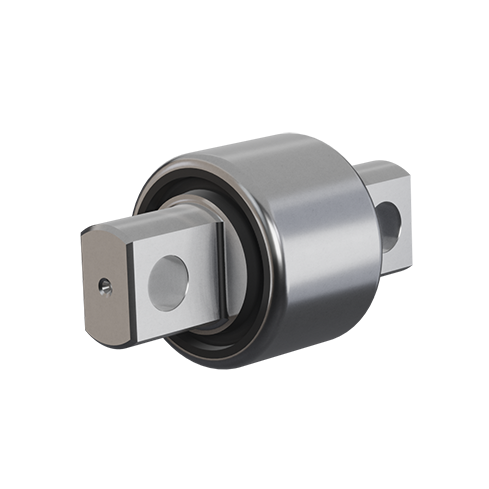
Rubber-metal spherical bearings are elastic bearings that combine ball-joint-like mobility with the advantages of an elastic metal-elastomer connection. They allow for controlled movement in multiple axes while simultaneously damping vibrations and shocks.
Area of application
Rubber-metal spherical bearings are used in several key locations within the drive system of railway vehicles. Among other things, they provide reliable motor mounting and ensure stable, low-vibration support. They are also used to support gearboxes and drive shafts, where they safely transmit forces while compensating for misalignment. Another application is the bogie connection in the drive system, where the bearings enable precise force transmission and effectively dampen dynamic loads. In this way, they contribute significantly to the performance and longevity of railway vehicles and their components. Furthermore, they enable the efficient transmission of forces and torques - such as drive torques or reaction forces - and support stable force transmission within the vehicle. Another key advantage is the effective decoupling of vibrations from the vehicle frame.
Technical details
Spherical bearings, or ball joints, consist of an inner and outer metal component, as well as a rubber body vulcanized on both sides. In the drive system of a railway vehicle, they offer a number of technical advantages that significantly enhance their performance in railway operations. Their multiaxial elasticity enables precise angular movements, torsional deformations, and displacements, allowing complex dynamic loads to be safely absorbed. At the same time, they provide high vibration and structure-borne noise damping, thereby reducing noise and reliably protecting adjacent components. Thanks to their ability to withstand high dynamic loads, they are ideally suited for strong drive and running dynamics forces. In addition, they are extremely resistant to environmental influences such as temperature changes, lubricants and aging.
Characteristics
Rubber-metal spherical bearings used in the drivetrains of railway vehicles are characterized by special properties that make them indispensable for the described use. Their multiaxial mobility allows for flexible adaptation to dynamic operating conditions while the elastic force transmission ensures controlled and reliable force transfer. At the same time, they offer high vibration and structure-borne noise damping, which improves both ride comfort and the service life of the components. Thanks to their ability to absorb high dynamic loads, they are ideally suited for demanding drive concepts. In addition, they effectively compensate for misalignments in the system and demonstrate excellent environmental resistance. All these features contribute to the long service life of spherical bearings in railway operations.