
Spherical Bearing: key component in bogies
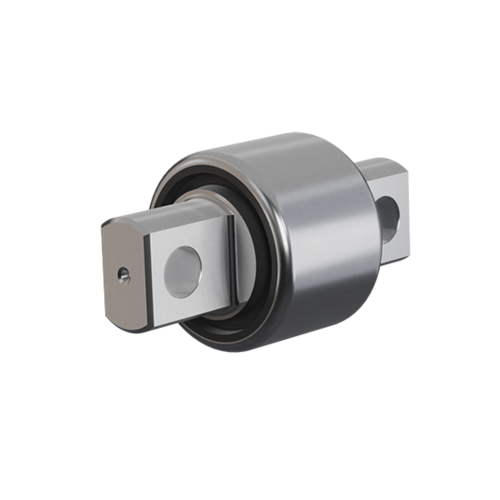
The spherical bearing (also known as a ball joint) is a bearing subjected to stress from all directions, making it ideal for use in control arms and shock absorbers. Spherical bearings are available in versions with a bore or an inner core as well as with a one-piece or segmented outer tube. They are also used for suspending and mounting assemblies in the bogie.
Area of application
Spherical bearings, also known as ball joints, are used in the bogies of railway vehicles wherever angularly adjustable, robust and heavy-duty connections are required - for example, on couplings, in car body-to-bogie connections or in traction rods. They are designed to safely absorb large forces and reliably compensate for angular or positional misalignments, thereby enabling precise swivel and bearing movements even under extreme operating conditions. As such, they are classified as safety-critical bearing types that must meet particularly high requirements in the railway vehicle sector.
Technical details
Spherical bearings or ball joints consist of an outer bearing ring and an inner spherical metal component, which, depending on the design, may be solid or feature a bore for bolt connections. They combine a spherical bearing geometry with an elastic rubber element that is firmly vulcanized between the inner and outer metal components. This allows them to safely accommodate angular deflections, misalignments and dynamic movements in the bogie while simultaneously transmitting radial, axial and combined loads. A key technical feature is the vulcanization of the elastomer between the inner and outer metal parts, which creates a permanent form- and force-fit connection. This enables defined elasticity, progressive spring characteristics and high fatigue strength under alternating load cycles. In many designs - such as segmented spherical bearings - the elastomer is preloaded to increase service life, stiffness and stability.
Characteristics
The distinctive features of spherical bearings lie in their high robustness, wear resistance and reliability which are particularly necessary for demanding applications such as couplings, tilting systems or track-guiding mechanisms. Rubber-metal spherical bearings are also designed to allow for multi-directional movement, tolerate the effects of dirt and moisture and operate reliably even under extreme operating conditions. These properties make them key bearing components in couplings, suspension control arms, cross-members and car body to bogie connections in railway vehicles. In the railway industry they are an example of a vibration-isolating component that effectively dampen vibrations, structure-borne noise and impact forces, thereby significantly improving smoothness of operation and ride comfort.