
Lithography Systems
Rubber and metal damping elements play an important role in lithography systems and in the manufacture of microchips, as these processes are extremely sensitive to vibrations, shock loads, and even the slightest disruptive movements. Among other things, they are used to decouple optics, exposure units and high-precision positioning systems from vibrations, thereby reliably enabling precise patterning.
Area of application
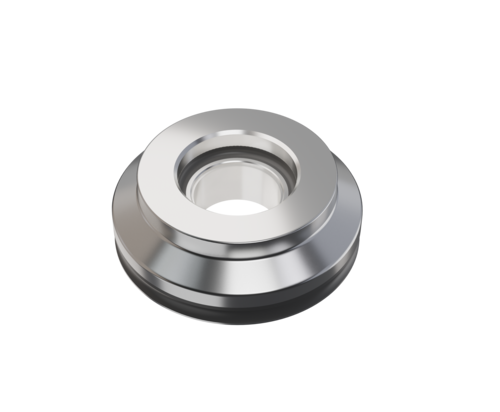
Rubber and metal damping mounts are used in lithography systems to reliably isolate high-precision components, such as optics and positioning systems, from environmental and machine vibrations. This minimizes even the slightest disturbances in the nanometer range and ensures high alignment and exposure accuracy. Technically, these damping elements are designed for low natural frequencies, defined stiffness and high internal damping. The rubber body absorbs high- and low-frequency vibrations, while metal inserts ensure the necessary force transmission, dimensional stability and positioning accuracy. Key advantages include very high vibration isolation combined with high mechanical stability, low creep and relaxation tendencies, as well as long-term and temperature stability. The compact, maintenance-free design supports consistent process accuracy and high system availability.
Technical details
In lithography systems, rubber and metal damping elements are used to protect extremely sensitive optical and mechanical processes from microvibrations. Due to their viscoelastic behavior, rubber-based elements offer high internal damping and are suitable for absorbing high-frequency disturbances; however, they present challenges in terms of temperature stability and long-term performance. Metal damping elements, such as precision springs or wire rope isolators, are characterized by very high stiffness, load-bearing capacity and the ability to achieve low natural frequencies, which allows them to effectively isolate low-frequency vibrations, albeit with low inherent damping. For this reason, combined rubber-metal elements or multi-stage isolation systems are frequently used in lithography systems to ensure both the highest positioning accuracy in the nanometer range and stable decoupling from environmental and machine vibrations.
Characteristics
The most important characteristics of rubber and metal damping elements in lithography systems are precisely tuned stiffness, a defined degree of damping and a very low natural frequency for the effective isolation of even the smallest vibrations. Rubber offers high internal damping and is particularly effective at reducing high-frequency vibrations; however, it is sensitive to temperature changes and aging. Metal elements offer high dimensional stability, load-bearing capacity and long-term consistency, as well as the ability to isolate low-frequency disturbances; however, they exhibit only low inherent damping. When combined, both materials enable stable, reproducible vibration decoupling in the nanometer range, which is crucial for accuracy and process reliability in lithography systems.