
Socket
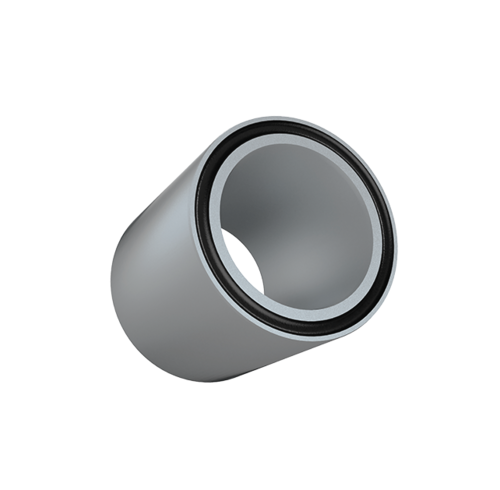
Rubber and metal bushings, as elastic connecting elements, are used in mechanical and plant engineering as well as in industrial technology to flexibly connect moving or vibration-subjected components. They are usually made of elastomer or rubber-metal composites and enable the compensation of vibrations, shocks, tolerances and misalignments. Typical applications include bearing points, articulated joints, swing arms and machine frames in industrial systems.
Area of application
Bushings, as elastic connecting elements, are used in mechanical and plant engineering for low-vibration mounting and connection of moving components. Typical applications include joints, swivel arms, machine frames and axle and bearing points where forces must be transmitted elastically. In industrial engineering, they serve to compensate for tolerances, misalignments and relative movements under dynamic loads. In addition, bushings are frequently used to reduce noise and vibration in heavily loaded assemblies.
Technical details
Bushings, as elastic connecting elements, typically consist of a vulcanized elastomer body that is firmly bonded to an inner and/or outer sleeve made of steel or aluminum. This design enables force-fit power transmission while simultaneously damping vibrations and shocks through the elastomer. Technically, bushings have defined compressive, tensile and shear stiffnesses as well as nonlinear characteristic curves to safely accommodate various load conditions. They compensate for misalignment and angular errors, operate maintenance-free, and - depending on the elastomer compound - are largely resistant to temperature, aging and media exposure.
Characteristics
Rubber and metal bushings are elastic connecting elements used in mechanical engineering and industrial technology for the mounting, guidance and vibration isolation of components. They typically consist of an inner and an outer metal sleeve, between which an elastic rubber body is permanently vulcanized. This design allows movements and forces to be transmitted between two components while effectively damping vibrations, shocks and noise. A key advantage of these components is that they are maintenance-free, as no lubrication is required and there are no metal sliding surfaces. They allow for limited movement in the radial, axial and torsional directions, thereby compensating for misalignment and minor displacements between the connected components. At the same time, they provide vibration isolation and help reduce wear and noise emissions. The stiffness and damping effect of the bushing can be specifically tailored to the respective application by selecting the elastomer material and optimizing the geometric design. Typical applications include mountings for machines, motors, pumps, conveyor systems, vehicle components and other industrial units. Due to their combination of load-bearing capacity, elasticity and damping properties, rubber-metal bushings represent a cost-effective and reliable solution for many dynamically loaded connections.