
Rear guard | Fender
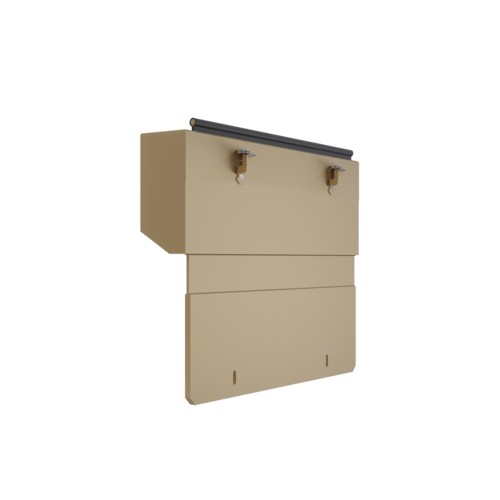
Rear guards or fenders made of rubber and metal are used in defense and military technology as flexible track covers to divert dirt, mud, stones and debris away from the rear of the vehicle and to reduce noise and vibrations. Rear guards provide enhanced mechanical protection against abrasion, impacts and flying debris, particularly on heavy tracked vehicles. They protect the rear track assembly, following vehicles and personnel and further enhance operational safety under demanding conditions.
Area of application
Rubber and metal rear guards or fenders are mounted on the rear section of the track assembly in protective and military engineering, usually directly behind the last idler or drive sprocket, to divert ejected mud, rocks, water and track debris toward the rear. They are used particularly on transport, engineer and support vehicles, where flexibility, noise reduction and protection of objects and personnel behind the vehicle are important. Rear skirts are primarily used on heavy combat and recovery tanks and are securely attached to the rear of the vehicle hull or to the track guard frame. There, they provide robust protection for the rear section of the tracks as well as for following vehicles and infrastructure against shrapnel, impacts and mechanical stress.
Technical details
Rubber and metal rear guards or fenders are made of highly abrasion-resistant elastomer; they are often constructed in multiple layers and reinforced with textile or steel mesh inserts or steel plates to increase tear resistance, dimensional stability, durability and temperature resistance. They are flexibly suspended, designed to dampen vibrations and modularly attached to the rear structure or track frame so that they can follow the movements of the track. Their technical design is either rigid or partially movable and provides maximum resistance to abrasion, impact, blows and shrapnel in the rear track area.
Characteristics
Rubber and metal rear guards or fenders are characterized by high flexibility, effective energy and vibration damping and a significant reduction in dirt, water and stone throw behind the tracked vehicle. They reduce noise and are particularly resistant to abrasion, projectiles and temperature fluctuations. Rear skirts offer high mechanical strength, excellent protection against splinters and impacts and resistance to thermal and structural stresses. They increase protection for following vehicles and personnel, improve operational safety and contribute to the longevity of the track system.