
Anti roll bar: Stabilization of the vehicle car body
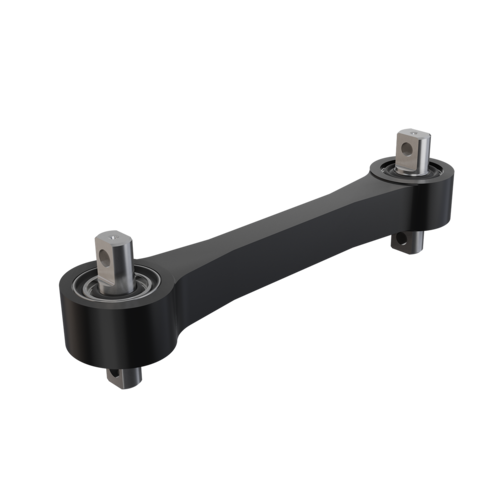
The anti roll bar stabilizes the railway vehicle’s car body relative to the bogie and limits its roll movements. It connects the car body to the bogie frame and ensures controlled vehicle movement, particularly when traveling through curves or when subjected to lateral forces, thereby improving ride comfort, smoothness and safety.
Area of application
The anti roll bar is used in the bogies of railway vehicles to limit and stabilize the rolling motions of the car body. It forms an important connection between the car body and the bogie frame, playing a central guiding role in the secondary suspension system. Particularly when traveling through curves, during lateral disturbances or during dynamic movements of the car body, the anti roll bar ensures that rolling motions are controlled and that the car body does not tilt excessively to the side. As a result, it contributes significantly to improving ride stability, ride comfort and safety. This component is primarily used in vehicles with high requirements for smooth operation and comfort, such as multiple-unit trains, trams or vehicles with air suspension.
Technical details
The anti-roll bar typically consists of a rigid, elongated rod or tube that is connected at both ends to the car body and the bogie frame via articulated bearings—usually rubber-metal bushings or spherical bearings. These articulated bearings allow for the necessary rotational and pivoting movements without transmitting excessively high forces or moments. Technically, the bar acts as a force-guiding element: It transfers the roll and lateral forces that occur during operation in a controlled manner from the car body to the bogie and ensures that lateral movements do not occur without damping. The anti roll bar serves as a guiding and stabilizing function. Thanks to its rigid yet articulated design, it complements the comparatively soft air suspension by ensuring the necessary lateral stiffness and roll stability of the vehicle, thereby enabling a stable and smooth ride.
Characteristics
The key characteristics of a anti roll bar lie in its ability to effectively stabilize the roll and lateral movements of the car body while simultaneously relieving stress on the other suspension components. Thanks to its rigid yet articulated design, it significantly contributes to increased driving stability and safety by preventing excessive body roll and providing controlled restoring forces. The rubber-metal bushings or spherical bearings used allow for the necessary rotational movements while also isolating vibrations, ensuring that the pendulum remains low-maintenance and durable. It also reduces lateral loads on air spring bellows, control arms, and the pivot bearing, and distributes the resulting forces evenly throughout the vehicle. Its robust construction, combined with elastic mounting points, ensures high overall reliability, a long service life and effective support for the entire suspension and damping system in the bogie.