
Rubber spring (donut / telephone)
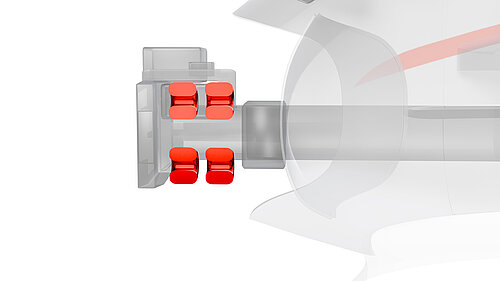
Spring components in railcar couplers - often colloquially referred to as rubber rings, “domuts” or “telephones” due to their shape - play a central role in the mechanical coupling of railway vehicles. They ensure that tensile and compressive forces are safely transmitted, impacts are dampened and dynamic load cycles are balanced.
Area of application
Coupling systems in railway vehicles - such as screw couplings, center-buffer couplings or automatic couplings - include special damping and spring components that reduce load spikes during starting, braking or shunting and increase the stability of the entire train set. This not only improves ride comfort but also reduces wear on the coupler, bogie and car body.
Technical details
Elastic or hydraulically operated spring and damping elements are increasingly being used in coupling systems to absorb unexpected movements or impact energy, thereby ensuring reliable operation during daily use. Automatic coupling systems, in particular, combine these spring components with mechanical, pneumatic and electrical interfaces to ensure a durable, vibration-reduced connection between two railcars. As a result the elastic rubber springs (so called donuts and telephones) are an indispensable part of efficient coupling technology and contribute significantly to safety, durability and efficiency in railway transport.
Characteristics
Rubber springs in railcar couplings are designed to effectively absorb load cycles, shocks, and tensile and compressive forces within the coupling system, thereby stabilizing the mechanical connection between railcar bodies. To achieve this, high-performance couplings incorporate damping elements that reduce the load peaks generated during travel, starting or shunting and provide long-term relief for the coupling. Particularly in automatic and semi-permanent couplings, the rubber springs also act as vibration isolators to compensate for unexpected movements within the train set and ensure a smooth, reliable connection. Since car body couplings are subjected to severe shock and compressive loads during operation, their rubber springs must be highly cycle-resistant, low-wear and tolerant of positional and motion errors. At the same time, they help protect the entire coupling unit from structural overloads.
Variants
Rubber ring (Donut)
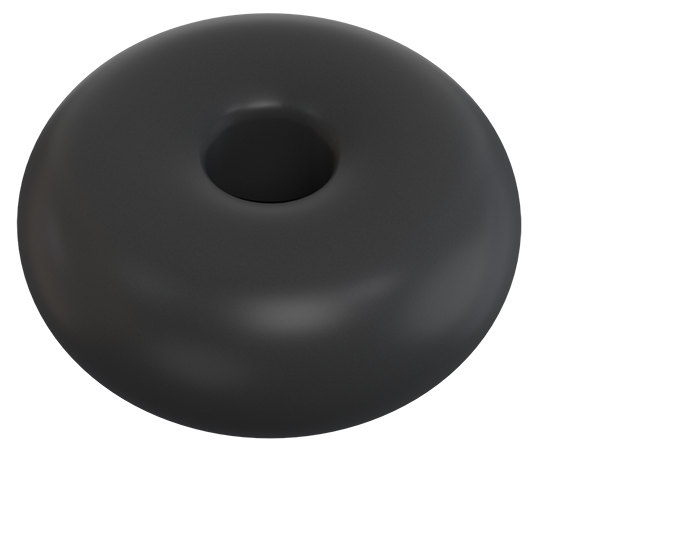
A so-called “donut” is a ring-shaped rubber-spring component used in automatic couplings on railway vehicles to elastically transmit tensile and compressive forces. Thanks to its shape and material structure, it absorbs shocks during coupling, reduces dynamic load cycles and minimizes the transmission of vibrations and noise to the car body. The spring element has a progressive spring characteristic curve that gently absorbs small movements and enables significantly stiffer force absorption under higher loads. This protects the coupling frame and interface components from overload.
During operation, the donut compensates for relative movements in the axial, radial and torsional directions, thereby contributing to a stable and durable force transmission in the coupling system. Thanks to its high durability, weather resistance and virtually maintenance-free operation, this spring component is ideally suited for the demanding operating conditions in railway vehicles and serves as a key component in the coupling’s vibration, energy, and safety management.
Rubber spring (Telephone)
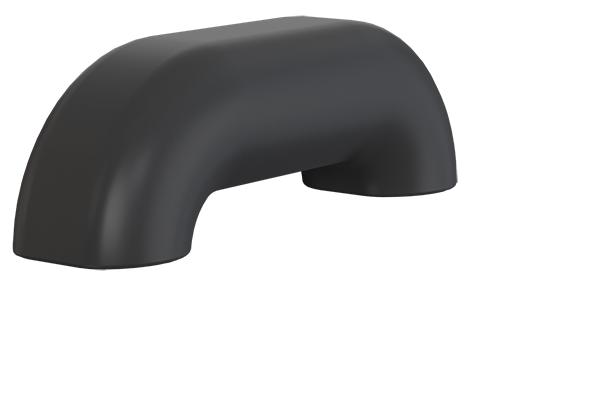
A so-called “telephone” is an elastic rubber spring used in automatic couplers on railway vehicles. It serves to elastically transmit tensile and compressive forces, dampen impacts during coupling and reliably compensate for vibrations and relative movements within the coupling. In this way, it protects the coupling head and subframe from high dynamic loads. The rubber spring has a progressive spring characteristic curve; it acts softly and dampingly during small movements and stably and load-bearing under high forces. At the same time, it allows for multidirectional deformations—axial, radial and torsional—which is crucial for the operational performance and energy management of the coupler. Thanks to its high durability, weather resistance and virtually maintenance-free operation, the rubber spring contributes significantly to the longevity, noise reduction and operational reliability of coupling systems in railway vehicles.