
Cab Mount
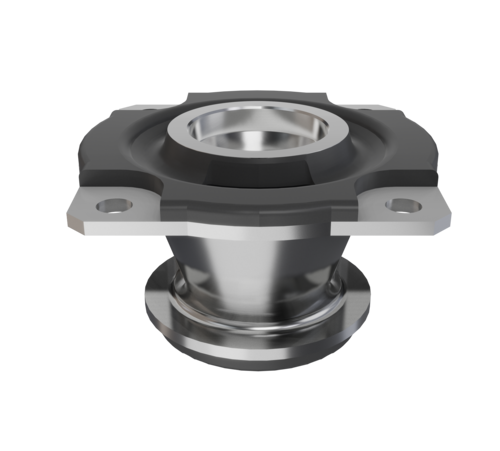
The cab mount, also known as the cab suspension, in the commercial vehicle sector is a vibration- and noise-damping mount that connects the truck or commercial vehicle cab to the chassis. It ensures that the driver and passengers are protected from shocks, impacts and engine vibrations.
Area of application
Rubber-and-metal cab mounts are used in the commercial vehicle sector to elastically connect the driver’s cab to the vehicle frame, thereby isolating the driver from vibrations, noise and impacts. It is used in nearly all trucks, buses and off-road vehicles, where it compensates for movements between the frame and the cab and improves ride comfort as well as the durability of the cab structure. It is typically installed at four points between the cab and the chassis: two mounts at the front, which usually feature a pivoting connection to accommodate torsional movements, and two mounts at the rear, often with integrated spring and damping technology, which ensure stability and controlled movement.
Technical details
A rubber-metal cab mount consists of an elastic rubber body that is firmly vulcanized to inner and outer metal components. The metal components serve as stable mounting surfaces for the cab and the chassis, while the rubber performs the key function of damping oscillations and vibrations. Thanks to its special geometry - often designed as a cylindrical or conical rubber-metal element - the mount can absorb both vertical and lateral forces while simultaneously compensating for torsional movements. The rubber acts as a spring-like damping element that filters out stresses such as vibrations and shocks from the engine or the road, as well as frame twisting. The metal guide ensures precise positioning and durability, while the combination of materials as a whole enables a robust, low-maintenance mounting system for the cab. In many cases, these mounts are equipped with a shear protection device.
Characteristics
A rubber-and-metal cab mount offers several key advantages in the commercial vehicle sector. The elastic rubber component effectively dampens vibrations, noise and shocks, thereby improving ride comfort. At the same time, the metal structure ensures high stability, precise force transmission, and a long service life under demanding operating conditions. The combination of rubber and metal also allows for the absorption of multi-axial movements - such as vertical, lateral, and torsional forces - without overloading the cab structure. Overall, the rubber-and-metal cab mount is robust, low-maintenance and plays a crucial role in protecting the cab and chassis.