
Engine Mount
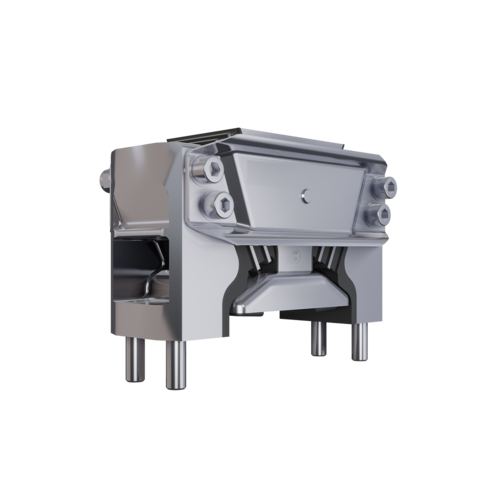
Rubber-to-metal bonded and assembled engine mounts are used in defense and protection technology to effectively isolate motors and power units from vibrations, shocks and structure-borne noise. They combine high mechanical load-bearing capacity with elastic damping, thereby protecting adjacent structures and sensitive systems. As a result, they contribute significantly to the reliability, noise reduction, and service life of drive units under extreme operating conditions.
Area of application
Rubber-to-metal bonded and assembled engine mounts are used in military and armored vehicles, such as wheeled and tracked vehicles, to mount power units. They are used in stationary and mobile power generators, emergency power systems and pumping and ventilation systems in military infrastructure. They are also used in maritime systems, such as shipboard power units, as well as in ground-based aviation and sensor systems, to provide low-vibration mounting for the units.
Technical details
Rubber-metal motor mounts typically consist of inner and outer metal parts that are firmly bonded to a vulcanized elastomer body. The rubber body is specifically designed in terms of hardness, geometry and damping characteristics to achieve defined natural frequencies and degrees of isolation. Additional design features such as mechanical stops, hollow chambers or progressive rubber cross-sections limit movement and protect against overload. For use in defense and protection technology, motor mounts are often designed to be highly resistant to temperature, oils, fuels, moisture and chemical influences.
Characteristics
Engine mounts for civil defense and military applications are characterized, depending on the specification, by a defined fail-safe behavior that ensures a secure metallic support remains in place in the event of damage. They are designed for maximum dimensional and functional stability over long service life, with controlled aging behavior and minimal settlement or creep. Specially optimized designs can reduce the detectable acoustic and structural signature of systems and support requirements for low observability. In addition, they meet strict military standards and qualification tests, including shock, endurance and environmental tests under realistic operational conditions.