
Guide Spring: elastic axle and wheel guidance
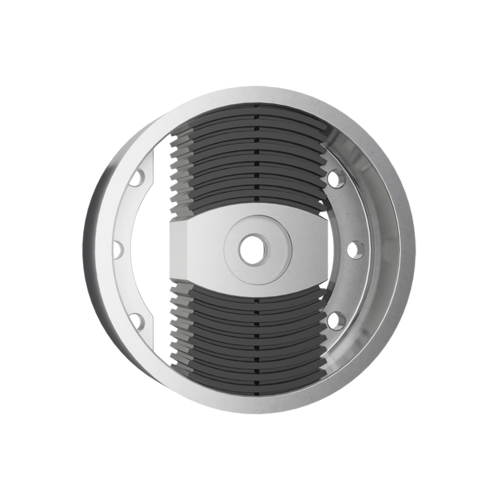
Guide springs in the primary stage allow for elastic wheel and axle guidance relative to the bogie frame. They combine defined lateral and longitudinal stiffness with vertical spring deflection, simultaneously performing spring and damping functions, ensuring stable track guidance and reduced vibrations and contributing to lower maintenance requirements.
Area of application
Typical applications for guide springs in the primary spring stage include any situation where axles must be guided elastically relative to the bogie frame. They are primarily used in streetcars, light rail and subway trains and low-floor vehicles as well as in regional and motor cars with light to medium axle loads. They are particularly common in compact bogies, where suspension, damping, and wheel guidance are designed to be combined using as few components as possible.
Technical details
Guide springs in the primary spring stage transmit not only vertical and lateral loads but also the longitudinal forces generated during acceleration and braking from the wheel set to the bogie frame. They feature high shear stiffness to limit relative twisting of the axle bearing and are often installed with a defined preload to stabilize the elastomer’s nonlinear spring and damping behavior. In addition, they are designed to account for the frequency-dependent stiffness of the elastomer in order to prevent unwanted resonances. They must be capable of withstanding high cyclic load cycles over millions of load cycles on a long-term basis. Typically, these consist of a multilayer bushing, with kidney-shaped recesses in the rubber body as needed to generate defined longitudinal and transverse stiffnesses.
Characteristics
Guide springs feature high resistance to aging and chemical exposure in the elastomer. They have tight tolerances on spring and stiffness characteristics, ensuring that the dynamic behavior between the two wheel set bearings of a bogie remains precisely balanced. The assemblies are often designed to be fail-safe, ensuring that no uncontrolled axle movements occur in the event of overload or damage. The geometry is designed according to the dynamic operating requirements so that the spring forces act linearly or in a specifically progressive manner.