
Insulator
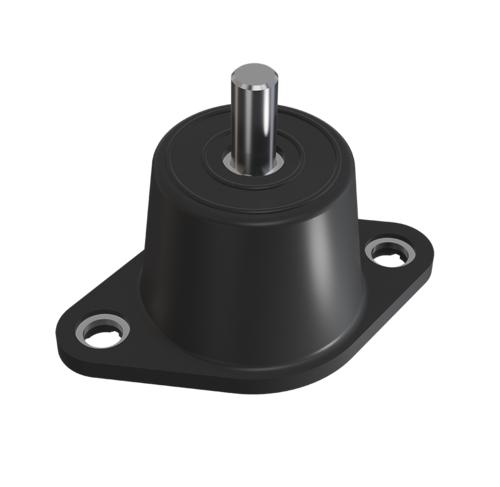
Rubber and metal isolators are mounting elements used in mechanical and plant engineering to effectively isolate vibrations, shocks and noise. They decouple machines and assemblies from the foundation, thereby reducing the transmission of vibrations and structure-borne noise. Isolators play a key role in ensuring the operational safety, smooth operation and service life of machines.
Area of application
Rubber and metal isolators are used as mounting elements in mechanical and plant engineering, particularly in vibration- and noise-sensitive applications. Typical areas of application include high-precision machines, measurement and testing systems, as well as CNC and machine tools, where vibrations can compromise process quality. Other specialized applications can be found in the manufacture of motors, generators, and compressors, where they are used to decouple vibrations from the structure. In building and plant engineering as well - for example, for machines installed in production halls or on false ceilings - isolators ensure effective vibration and structure-borne noise reduction.
Technical details
Insulators used as mounting elements in mechanical and plant engineering are primarily made of elastic materials such as rubber or elastomers, often combined with metal plates, threaded bolts or sleeves for force transmission. The elastic core is engineered to provide defined stiffness and damping values for specific load and frequency ranges. Key technical specifications include the permissible static and dynamic loads, the damping capacity and the natural frequency of the isolator. Depending on the design, isolators are resistant to temperature, oil, and aging and are designed for long-term operation. Their design enables effective decoupling of vibrations and structure-borne noise while simultaneously providing secure support for the machine.
Characteristics
Isolators used as mounting elements are characterized by their high vibration and structure-borne sound damping, enabling effective decoupling of the machine from the foundation. They have defined elastic properties that specifically reduce vibrations and prevent resonance. At the same time, they provide sufficient load-bearing capacity and dimensional stability to ensure safe machine operation. Furthermore, isolators are largely resistant to environmental influences, making them ideal for long-term industrial use.