
Elastic support bearings for drive systems
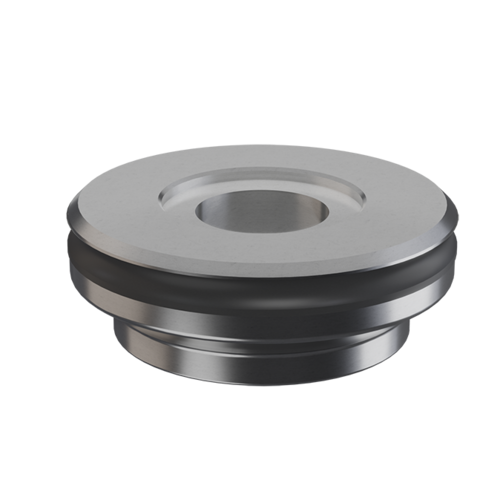
A rubber-metal support bearing used in the drive systems of railway vehicles is an elastic bearing component designed to provide elastic support for motors, transmissions or drive components relative to the bogie or car body while simultaneously transmitting forces in a controlled manner.
Area of application
Support bearings are used in railway vehicles when drive components need to be guided elastically while also being stably supported. They serve to support traction motors mounted on the vehicle and provide their guidance and support. They enable vibration-decoupled mounting of gearboxes. In addition, they ensure effective decoupling of entire drive units - in both low-floor and high-floor vehicles - and thus contribute significantly to smooth, low-wear power transmission.
Technical details
Rubber-metal support bearings consist of an inner and outer metal sleeve connected by a vulcanized elastomer layer. This layer performs the actual technical function: It allows for defined elastic deformations in the radial and axial directions while simultaneously damping vibrations and shocks. The elastomer compound is precisely engineered for railway applications in terms of stiffness, damping capacity and resistance to temperature and aging.
Characteristics
Rubber-metal support bearings are characterized by a vulcanized, form-fit metal-elastomer bond that ensures a defined and durable elastic function. They possess multiaxial elasticity, as the elastomer layer accommodates compressive, shear and torsional movements simultaneously, thereby absorbing complex loads. At the same time, they provide highly effective vibration and structure-borne noise damping because they effectively isolate engine, transmission and chassis vibrations and relieve stress on structural components. Furthermore, they are designed to absorb high dynamic loads as well as their own weight and can reliably transmit both vertical and horizontal force components. Another advantage is their elastic compensation of misalignments, which offsets tolerances and relative movements within the powertrain. In chassis mountings, they enable precise force transmission by controlled transfer of vertical and horizontal forces while simultaneously damping both radial and axial movements. In addition, their spring and damping characteristics can be specifically adjusted, for example by varying the elastomer hardness or geometry. Finally, they offer high resistance to environmental influences such as temperature fluctuations, lubricants and aging, thereby ensuring their long-term operational reliability in railway service.