
Plates
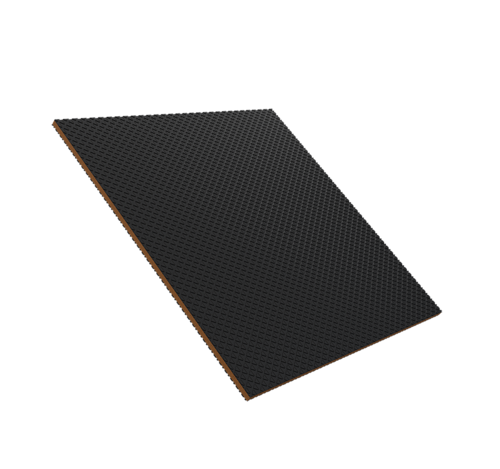
Plates - composite parts made of rubber and materials such as metal, cork, or plastic - are used in mechanical and plant engineering as well as in industrial technology as flat mounting elements for vibration, shock and structure-borne sound isolation. They combine a load-bearing insert with an elastic rubber body that reliably dampens vibrations and distributes loads evenly. Typical applications include the mounting of machines, systems, foundations and test stands to effectively decouple them from the substrate. The plates are also available in media-resistant versions made with special elastomers.
Area of application
Sheets made of rubber and various materials such as cork, metal and plastic are used in mechanical and plant engineering for the surface-mounted support and decoupling of machines, units and production facilities. They are used for foundation decoupling to prevent vibrations and structure-borne noise from being transmitted into buildings and structures. In industrial engineering, they are frequently used under test stands, compressors, pumps and fans. They are also suitable for applications where high loads must be evenly distributed while effectively reducing vibrations.
Technical details
Sheets made of a composite of rubber and materials such as cork, metal and plastic consist of an elastic rubber core that is firmly bonded to the inserts or cover layers to safely absorb loads. The rubber component provides vibration, shock and structure-borne sound damping, while the insert or cover layer ensures even force distribution and dimensional stability. Technically, they feature defined compressive and shear stiffnesses and are designed for high static loads. Material selection, rubber hardness and sheet geometry allow for application-specific customization for use in machinery, plant equipment and industrial applications, as well as media resistance according to specifications.
Characteristics
Pads made of rubber and materials such as cork, metal and plastic are characterized by their high vibration and structure-borne sound damping, combined with high load-bearing capacity and, where applicable, resistance to various media. They enable even load distribution and reduce point loads on foundations and machine frames. They are characterized by their robust, maintenance-free design as well as good resistance to aging, media and weathering, depending on the rubber compound. Due to their flat design, they are particularly suitable for stationary machines and systems with a high dead weight. In addition, they are easy to install and can be flexibly adapted to various industrial applications.
Variants
Cork Sheets
Rubber-cork sheets are used in mechanical and plant engineering for vibration and noise damping, as well as for elastic decoupling. Typical applications include machine foundations, unit mounts, housing supports, and sealing and leveling elements. They reduce vibrations, compensate for unevenness, and protect components and structures. The material consists of cork granules bound with elastomers such as NBR or NR and compressed under pressure. It is characterized by defined degrees of hardness, low compression set, and good damping properties. Depending on the version, it is resistant to oil, fuel, and temperature, and can be manufactured in various thicknesses and bulk densities. This makes it suitable for static and moderately dynamic loads. Key advantages include effective vibration and noise damping, high compressive elasticity, and reliable compensation for surface irregularities and manufacturing tolerances. In addition, rubber-cork sheets offer good sealing and insulation properties against liquids, dust, and air. Their resistance to aging and durability make them a versatile and low-maintenance solution for industrial applications.
Perforated plates
Rubber perforated plates are elastic rubber elements with regularly spaced holes that are used in mechanical and plant engineering for vibration and noise damping, as well as for elastic decoupling. Typical applications include machine foundations, equipment mounts, transport and conveyor systems, and non-slip pads. They reduce vibrations, distribute forces evenly, and protect components and surfaces from wear. The sheets are made of rubber materials such as NR, SBR, or NBR. The strategically arranged perforated structure increases elasticity and allows for better adaptation to loads and uneven surfaces. The hole geometry, material hardness, and sheet thickness are designed to meet the respective load and damping requirements. They are suitable for static and dynamic loads and, depending on the material quality, offer resistance to oil, moisture, aging, and temperature. Key advantages include high vibration and noise damping, even load distribution, and good resilience. In addition, rubber perforated plates are slip-resistant, wear-resistant, and durable. Their versatility and ease of integration make them a low-maintenance solution for industrial applications.
Dimpled/Ribbed Panels
Rubber stud-and-rib mats are used in mechanical and plant engineering as slip-resistant and vibration-damping floor and support mats. Typical applications include production areas, machine workstations, maintenance areas, and walking and standing surfaces. They enhance workplace safety, protect machines and workpieces from impacts and vibrations, and, thanks to their textured surface, provide a secure grip even when wet or dirty. In addition, they facilitate the drainage of liquids and reduce fatigue. The mats are manufactured from elastomers such as NR, SBR, or NBR and are available in various thicknesses and profiles. The combination of a studded and ribbed structure improves slip resistance and increases elastic resilience. They are designed for high mechanical stress as well as static and moderate dynamic loads. Depending on the material, they offer resistance to oil, moisture, chemicals, and temperature fluctuations. Key benefits include high slip resistance, effective removal of dirt, chips, and liquids, and good vibration damping. In addition, stud-and-rib mats are robust, wear-resistant, durable, and easy to clean, making them a cost-effective solution for continuous industrial use.