
Decoupling element
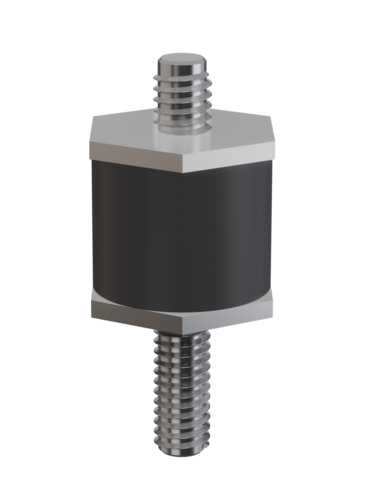
Rubber-metal isolation mounts are elastic components used in commercial vehicles to effectively reduce vibrations, noise and shocks between various vehicle components. They consist of a damping rubber body that is firmly connected to metal elements, allowing them to absorb vibrations while simultaneously enabling safe power transmission.
Area of application
Rubber and metal isolation elements are used in commercial vehicles wherever vibrations, noise and shocks between components need to be reduced. They are primarily used in engine and transmission mounts to isolate powertrain vibrations from the vehicle frame and to improve both ride comfort and the service life of adjacent components. In the chassis area, they provide elastic isolation between axles, frame components and mounted elements, thereby reducing the transmission of harsh impacts, road irregularities and dynamic load changes. In addition, they are used in body systems, cab mountings and for mounting pumps, compressors or hydraulic units to minimize noise and protect sensitive components from overload.
Technical details
Rubber-and-metal decoupling elements consist of an elastic rubber body that is firmly bonded to metal components via vulcanized joints. This design enables reliable damping of vibrations and structure-borne noise, while the metal components ensure secure mounting and stable force transmission to the vehicle frame. The elastomer core absorbs vibrations, shocks, and dynamic loads in multiple directions, thereby reducing both axial and radial forces. Technically, decoupling elements are characterized by defined spring and damping characteristics, high fatigue strength and durable material properties that remain intact even under continuous load cycles. They are resistant to dirt, moisture and temperature fluctuations, which is crucial for use in the harsh everyday environment of commercial vehicles.
Characteristics
Rubber and metal decoupling elements are particularly effective at isolating vibrations and structure-borne noise, thereby significantly reducing the transmission path between the engine, transmission, body or powertrain components and the vehicle frame. Their elastic structure enables multidirectional damping, allowing them to absorb both axial and radial forces in a controlled manner. Through the combination of flexible elastomer and sturdy metal inserts, they ensure reliable power transmission while minimizing stress on the materials. In addition, they are fatigue-resistant, dimensionally stable over time and resistant to dirt, moisture, and extreme temperature fluctuations. These properties make them particularly reliable in demanding everyday use and ensure that noise, vibrations and peak loads are sustainably reduced, keeping vehicle components intact for longer.