
Optical Element
Rubber-metal bearings play a crucial role in the optical industry, as optical systems place the highest demands on stability, precision, and vibration-free operation. They are used wherever sensitive optics, sensors and measurement systems must be reliably protected against vibrations, shocks and environmental influences. Typical applications for rubber-metal bearings in the optical industry include optical measurement and testing systems, camera technology, laser systems, microscopes, projection systems and high-precision alignment and positioning units.
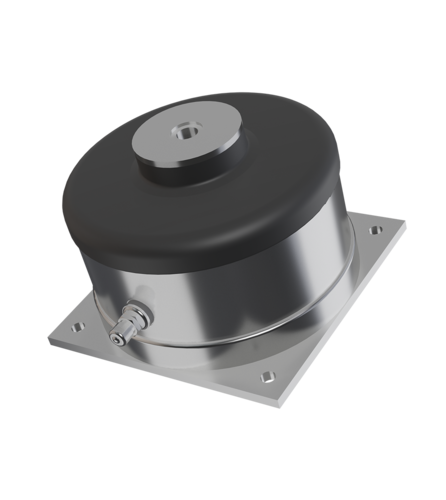
Area of application
Through targeted vibration decoupling, rubber-metal mounts in the optical industry ensure that mechanical disturbances are not transmitted to the optical components. This is essential for ensuring long-term image and measurement accuracy, focus stability and reproducible results. Especially in high-resolution applications, they contribute significantly to the operational reliability and performance of optical systems. The rubber-metal mounts consist of a specially tuned elastomer body that is firmly bonded to metal inserts. The rubber effectively dampens high- and low-frequency vibrations, while the metal ensures precise force transmission, dimensional stability and exact positioning. The mounts are designed for defined stiffness, low natural frequencies and high internal damping, and remain stable over the long term even under temperature fluctuations and continuous loading. Key features include excellent vibration damping, low creep and relaxation effects and a compact, maintenance-free design. As a result, rubber-metal bearings can be integrated even in confined spaces and contribute to a durable, stable structure.
Technical details
In optical applications, rubber and metal damping elements are used to protect sensitive lenses, mirrors and optical assemblies from even the slightest vibrations and positional deviations. Rubber-based elements offer high internal damping due to their viscoelastic behavior and are particularly effective at reducing high-frequency microvibrations and decoupling structure-borne noise. Metal damping elements, on the other hand, are characterized by high stiffness, dimensional stability and low creep, enabling precise positioning and the isolation of low-frequency disturbances, albeit with low inherent damping. In practice, combined rubber-metal solutions are frequently used to ensure stable, reproducible mounting and effective vibration isolation, which is crucial for optical accuracy and image quality.
Characteristics
The most important properties of rubber and metal damping elements for optical components are a very precisely defined stiffness, an appropriate degree of damping and long-term positional accuracy. Rubber offers high internal damping and effectively reduces high-frequency microvibrations, but it is susceptible to temperature changes and aging. Metal elements are characterized by high dimensional stability, low creep and constant mechanical properties; however, they have only low inherent damping. When combined, both materials enable a low-vibration, stable and reproducible mounting system, which is crucial for optical accuracy and image quality.