
Flange Mounting
A rubber-and-metal flange mount combines a machined flange surface with an elastic mounting component, thereby decoupling vibrations, shocks and structural noise from the overall system. The flat contact surface ensures a dimensionally stable and precisely aligned connection between two components, while the elastic core controls and absorbs movements and enables even load distribution across the entire end face. The combination of a metal support structure and an elastic spring element results in a compact, robust and vibration-isolating mounting point.
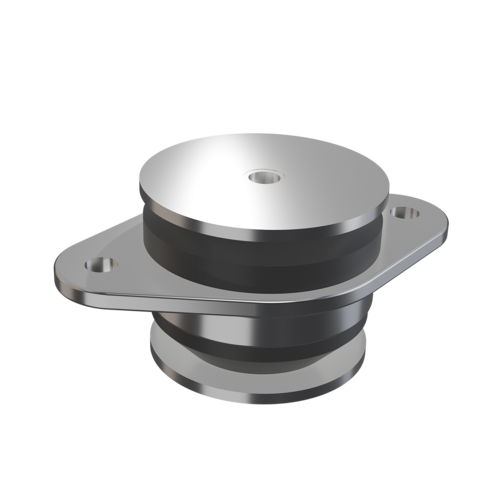
Area of application
Rubber-to-metal bonded flange mounts are used in machines and systems where components must be axially secured while simultaneously being elastically decoupled. Typical applications include housing junctions, unit mountings, connection points to support structures, vibration nodes or rotating assemblies with flat connections. Wherever a precise, easy-to-install and vibration-reduced connection is required, rubber-metal flange mountings offer a reliable solution. Thanks to their flat flange geometry, they can be easily integrated into existing designs and ensure reproducible positioning of the assembly.
Technical details
The flange mounting consists of a machined metal structure into which a rubber body is integrally embedded or vulcanized. The end faces are machined to specified surface roughness values, ensuring uniform contact pressure and a secure fit. Controlled dimensions allow for precise alignment, while the elastomer - depending on its hardness and geometry - acts as both a spring and a damping element. The elastic unit can absorb both axial and radial forces and has a characteristic spring curve that significantly determines the motion and load behavior of the entire bearing. As a result, the functional surface remains reproducibly elastic and ensures controlled motion absorption as well as a stable connection to the flanged counterpart.
Characteristics
Rubber-and-metal flange mounts offer a compact design, high dimensional stability and reliable vibration and noise reduction. The elastic mounting action protects adjacent components from shock loads, reduces vibration transmission and helps extend the service life of the entire system. The defined spring stiffness and the robust metal housing ensure safe, long-lasting power transmission while simultaneously providing elastic decoupling. This enables smooth operation, even load distribution, and a consistently stable connection even under varying dynamic loads.