
Secondary Spring Element (Hourglass Spring)
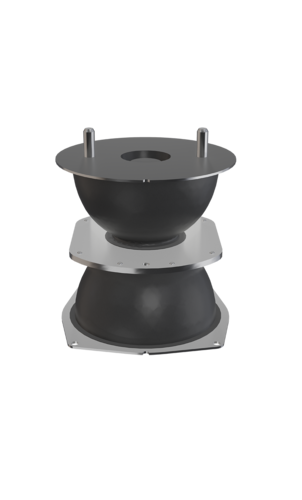
An hourglass spring is a spring component with a tapered geometry that is primarily used in the secondary suspension of railway vehicles. Thanks to its design, it provides a progressive spring rate curve and ensures good ride comfort, smooth operation and a robust, low-maintenance suspension system.
Area of application
Hourglass springs are used as secondary springs primarily in conventional railway vehicles that do not have air suspension or that require a robust, low-maintenance solution. Typical applications include passenger coaches, regional and commuter railway vehicles as well as trams and light rail vehicles, where they provide vertical support between the car body and the bogie frame. Due to their integrated damping and guidance functions, they are particularly well-suited for vehicles with limited installation space or simplified bogie kinematics, where suspension, damping, and, in some cases, guidance need to be combined into a single component.
Technical details
A rubber-metal hourglass spring used as a secondary spring in a railway vehicle is an elastic spring element with a tapered geometry, consisting of vulcanized elastomer and integrated metal reinforcements. The hourglass spring is specifically designed for stiffness, damping and resistance to aging. The spring withstands high static and dynamic vertical loads and, due to its shape, exhibits a progressive spring characteristic curve that responds softly to small excitations and more stiffly to large deflections. At the same time, it possesses defined transverse and longitudinal stiffnesses and can thus contribute to a limited extent to guiding the car body. The elastomer’s high internal damping capacity effectively reduces vibrations and noise. Overall, the design is compact, low-maintenance, wear-free and particularly suitable for vehicles without air suspension.
Characteristics
An hourglass spring, when used as a secondary spring in a railway vehicle, offers several practical advantages: Thanks to its tapered geometry, it exhibits a progressive spring characteristic curve, which smoothly filters out small irregularities and reliably absorbs larger disturbances. This improves both ride comfort and the vehicle’s smoothness. At the same time, the design allows for good lateral and longitudinal compliance combined with high vertical load-bearing capacity, which - particularly in conjunction with the primary suspension - leads to effective isolation from track irregularities. Hourglass springs are also very robust, low-maintenance and have a long service life, as they are subjected to uniform stress under load. Another advantage is their favorable damping behavior in combination with auxiliary dampers, as well as their comparatively simple installation and compact design.