
Gear coupling
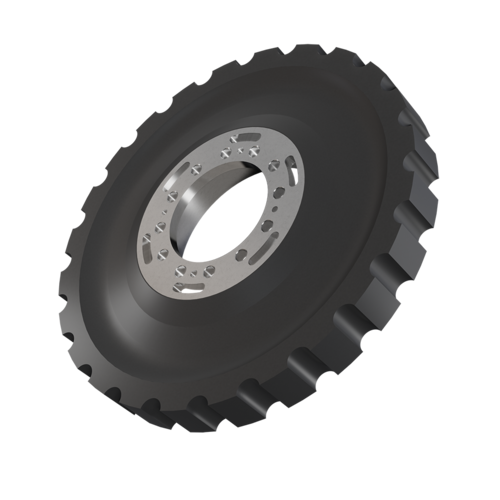
Rubber-metal composite gear couplings are used in shipbuilding as flexible coupling elements to transmit high torques while simultaneously damping torsional vibrations and shocks. They combine gear teeth for power transmission with elastic rubber elements for vibration isolation and misalignment compensation. Typical applications include ship propulsion systems, generator sets and auxiliary units.
Area of application
Rubber-metal composite gear couplings are specifically used in shipbuilding in propulsion and auxiliary machinery systems where high torques must be transmitted while simultaneously damping vibrations and shocks. Typical applications include coupling diesel engines to gearboxes, shaft systems or generators. They are particularly well-suited for systems subject to varying loads, torsional vibrations, and misalignment - conditions that frequently occur in maritime operations.
Technical details
Rubber-metal composite gear couplings used in shipbuilding consist of metal hubs that are coupled together via elastic rubber elements. The gear teeth transmit torque, while the rubber dampens torsional vibrations, shocks and load spikes. Technically, these couplings allow for the compensation of axial, radial and angular misalignment with defined torsional elasticity. They are designed to withstand high dynamic loads, alternating directions of rotation, temperature fluctuations and high humidity.
Characteristics
Rubber-metal composite gear couplings used in shipbuilding are characterized by a combination of high torque capacity and exceptional torsional elasticity. They provide effective damping of torsional vibrations and shock loads, thereby protecting drive trains from damage. A key feature is their ability to simultaneously compensate for misalignment, angular misalignment and axial misalignment. In addition, they exhibit high resistance to humidity, temperature fluctuations and continuous loads, making them ideally suited for maritime applications.