
Axle Guide Bearing: Controlling movements
An axle guide bearing is designed to reliably support the axle link - or longitudinal link - oriented in the direction of travel and to guide its movements in a controlled manner. Since lower control arms primarily absorb longitudinal forces, braking torques, and vertical wheel movements, the axle control arm bearing must transfer these forces stably to the bogie structure while simultaneously allowing for elastic movement so as not to impair the dynamics of the suspension.
Area of application
The axle guide bearing is located at the connection between the longitudinal control arm - which is oriented in the direction of ride - and the bogie frame, where it transmits longitudinal forces, braking torques and vertical wheel movements to the structure in a controlled manner. At the same time, its elastic mounting allows for small relative movements, dampens vibrations and keeps the wheel guidance stable. The axle guide bearing is primarily used in regional and long-distance trains.
Technical details
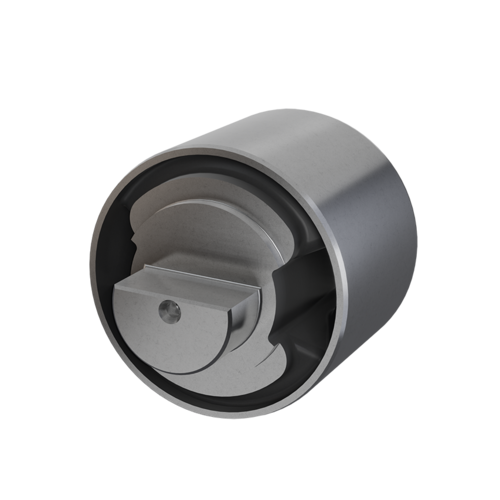
The axle guide bearing consists of a solid inner metal component and a vulcanized outer housing. Kidney-shaped recesses in the rubber body allow for different levels of radial stiffness. This elastic spring element enables movement in all directions while simultaneously damping the resulting forces. Depending on the requirements and application, a hydraulic axle guide bearing (HYDRALL) with fluid-filled chambers can be used. By coupling the overflow channels, the stiffness and damping are influenced depending on the excitation frequency.
Characteristics
The axle guide bearing plays a key role in ensuring the smooth running, driving stability, and operational reliability of a rail vehicle, and ensures precise wheel guidance in the direction of travel. Its elastic design compensates for component tolerances, thereby extending the service life of the entire bogie.
Components
Conventional Axle Guide Bearing
Conventional control arm bushings typically consist of an inner metal pin and an outer metal sleeve, with a vulcanized rubber body embedded between them. This elastic core allows for limited relative movement and can accommodate deformations in multiple directions without transmitting rigid forces directly into the structure.
Conventional rubber-metal axle-link bearings are used in bogies to provide an elastic yet force-locking connection between the axle link and the bogie frame. Such bearings fulfill several functions: They guide the axle rod, dampen vibrations, filter out shocks and compensate for tolerances as well as minor movements caused by track irregularities. In doing so, they reduce the load on adjacent components and contribute to smooth, stable vehicle operation. Thanks to their simple, robust design, rubber-metal axle link bearings require very little maintenance, are long-lasting and are suitable for a wide variety of bogie types - from streetcars to regional railway vehicles. During daily operation, these bearings are subjected to braking and acceleration forces as well as lateral and vertical loads, which the elastic rubber body can reliably absorb due to its material properties. This makes them a proven standard solution for the elastic guidance of axle control arms and vibration isolation in the undercarriage.
HYDRALL® Hydraulic Axle Guide Bearing
A hydraulic axle guide bearing is an advanced version of the classic rubber-metal axle guide bearing and is used in bogies to provide the axle-steering-link with elastic support that is also frequency-dependent. Although an elastomeric element is also incorporated between the inner and outer sleeves here, the bearing is supplemented by an additional hydraulic damping system. Typically, it consists of two or more fluid chambers connected by defined throttle channels. When the axle guide moves relative to the bogie frame, the fluid is displaced through these channels - resulting in speed- and frequency-dependent damping. This design allows for large low-frequency movements—such as those that occur when turning into curves or during curve adjustment - to be accommodated with low longitudinal stiffness. At the same time, the bearing offers significantly higher stiffness and damping in response to higher-frequency excitations - such as a series of rail joints or rapid load changes - since the exchange of fluid is delayed. As a result, a hydraulic axle-steering bearing improves both the dynamics and the stability of the bogie without hindering the wheel set’s adjustment movements. The elastomeric component continues to provide elastic support, facilitate force transmission and compensate for tolerances and component misalignments. The combination of elastomer and hydraulics results in a bearing capable of absorbing radial, axial and torsional forces while exhibiting precisely tuned frequency response. Hydraulic axle guide bearings are primarily used when there are high demands for smooth running, curve-running characteristics and wear reduction - particularly in regional trains, subways, high-speed railway vehicles and light rail transit.