
Axle Spring | Chevron Spring
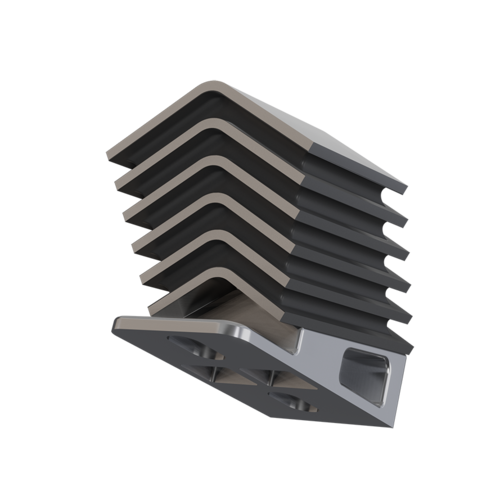
Axle springs (often referred to as chevron springs) serve as primary springs in the bogies of railway vehicles. They are used as decoupling elements between the wheel set and the vehicle’s bogie. As elastic decoupling elements, they ensure that vibrations and shocks originating from the wheel set are largely isolated from the bogie and the vehicle body. They are a central component of an effective suspension system.
Area of application
As the primary spring in the bogie of railway vehicles, the axle spring provides elastic support for the bogie frame relative to the wheel set. It absorbs operating loads, dampens track irregularities and reduces vibrations at the wheel-rail interface. Its special geometry allows for the precise adjustment of low lateral stiffness and high longitudinal stiffness to improve track guidance and ride safety. Thanks to its compact design and high fatigue strength, the angular spring is primarily used in streetcars, subways, regional trains and light- and medium-duty railcars and is considered a robust, low-maintenance solution for primary spring systems in rail vehicle construction. They ensure efficient, safe, and reliable operation.
Technical details
The mechanical properties of axle springs can be precisely described by their specific spring and damping characteristics. They exhibit a nonlinear, progressive spring characteristic curve. This design allows for the simultaneous absorption of vertical and horizontal forces. The damping provided by the elastomers used reduces resonance phenomena within the primary spring rate.
Characteristics
Axle springs are characterized by excellent force transmission under all vehicle conditions and, consequently, by high performance. At the same time, they ensure stable load distribution and reliable track holding. Additional benefits include reduced wear on bogie and vehicle components. Railway vehicle operators also benefit from the maintenance-free operation and long service life of these elastomer components.