
Layer Spring: damping element for railway vehicles
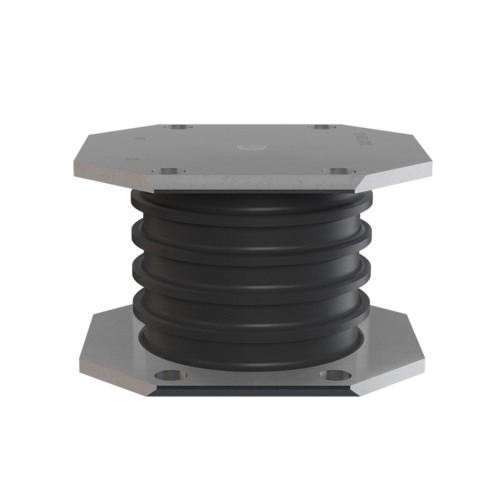
A layer spring (often referred to as a rubber laminated spring or elastomer laminated spring) is a component consisting of alternating layers of metal plates and elastomer layers. It is frequently used in the primary spring stage of railway vehicle bogies.
Area of application
The layer spring is primarily used in streetcars, light rail and subway trains, as well as other light rail vehicles. There, it serves as the primary spring between the axle and the bogie frame; its compact design and suspension and damping properties make it particularly advantageous. It is also suitable for low-floor vehicles, where installation space is limited. It ensures reliable, elastic wheel guidance and good vibration isolation and is maintenance-free.
Technical details
The layer spring consists of alternating metal plates and rubber layers, with the rubber layers providing elastic deformation and the metal plates providing the stability and structural integrity required for assembly. The elastomer layers provide a defined vertical and horizontal spring stiffness, enabling high transverse and longitudinal stiffness for wheel guidance.
Characteristics
A layer spring is characterized by its compact, multi-layer metal-elastomer construction, which combines a defined vertical spring stiffness with high lateral and longitudinal stiffness for wheel guidance. It provides a damping effect through the elastomer and operates with a defined spring rate. The spring characteristic curve is influenced by temperature and aging processes. Thanks to its robust, maintenance-free design, it is particularly well-suited for use as a primary spring in bogies on railway vehicles.