
Elastic Ring Spring Element in railway vehicles
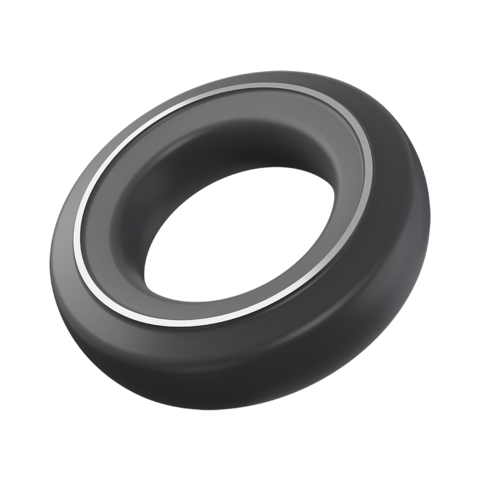
Older electric locomotives do not have a rigid drive system but rather what is known as a rubber ring spring drive. This drive system was introduced because of its advantages over other types of drive systems. Rubber ring spring elements consist of several segmented metal-elastomer segments arranged radially between the inner and outer bodies of a power transmission coupling. These segments act as elastic, vibration-damping elements and serve to smooth out torsional vibrations, absorb shocks from operation and thereby relieve mechanical stress on the motor and transmission. Because of their function, these elements are referred to as ring springs or ring spring segments.
Area of application
In older series of electric locomotives the motor and axle are not rigidly connected to each other but are mounted on partially spring-loaded bearings. This design serves, on the one hand, to isolate vibrations and shocks, since the axles continuously receive impacts from the track while the locomotive is in motion; without a flexible coupling, these impacts would be transmitted directly to the motor, leading to increased wear there. On the other hand, the suspension enables smooth power transmission, even though the AC traction motor generates pulsating torque. The rubber ring springs or ring spring segments used in the coupling smooth out these torque pulsations and ensure a smooth flow of power. Overall, the ring spring segments absorb the resulting dynamic effects and create a torsionally flexible, elastic connection between the motor and the wheel set gearbox, thereby ensuring both smooth operation and reduced mechanical stress on the drive components.
Technical details
A ring spring segment assembly, such as that used in a rubber ring spring coupling, generally consists of an metallic inner body that is mounted directly on the motor or gearbox and an metallic outer body that is connected to the wheel set gearbox. Between these two components is a firmly vulcanized rubber body. The ring spring segments are arranged in a ring configuration and transmit the applied torque through both frictional and positive engagement, but always with a defined degree of elasticity. Thanks to this design, the segments possess several important properties: They exhibit torsional elasticity, dampen vibrations, compensate for misalignment between the motor and the gearbox and reduce load peaks in the drivetrain, particularly during start-up. At the same time, they reliably protect the engine and transmission from the dynamic forces caused by track irregularities, resulting in smoother overall operation and reduced wear on the entire drive system.
Characteristics
The so-called ring spring segments in the drive consist of elastic rubber elements that are an integral part of the rubber ring spring drive. They provide a flexible yet vibration-damping connection between the motor and the axle, performing several key functions in the process. Thanks to their design, they effectively decouple the drive from shocks and vibrations, enable torsionally flexible power transmission and play a crucial role in reducing mechanical wear. At the same time, they promote smooth driving, ensure quiet engine operation, and prevent load spikes, which can occur particularly when starting off. Due to these diverse functions, the ring spring segments are an essential element for the operational behavior and long-term reliability of the vehicles.