
Threaded Buffer
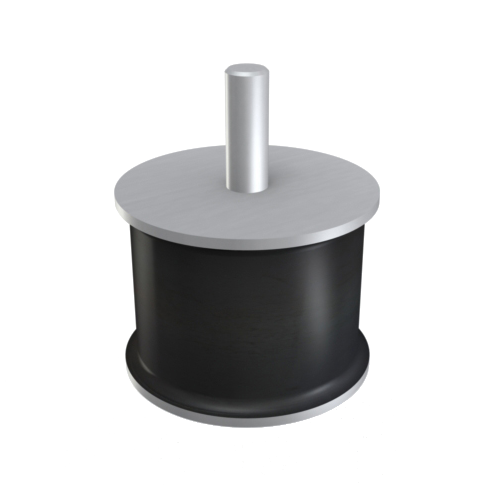
Rubber-and-metal threaded buffers are used in mechanical and plant engineering as well as in industrial technology as elastic connecting elements for vibration and shock absorption. They typically consist of an elastomer body with an internal or external metal thread and are easy to install. Their main applications include elastic mounting, limit stops and decoupling of machines, units and housings.
Area of application
Threaded buffers are specifically used in mechanical and plant engineering as vibration and shock absorbers for the elastic mounting of machines, units, and housings. Typical applications include stop limiters, end-position safety devices and the decoupling of moving or vibrating components. In industrial engineering, they are used in machine feet, covers, control panels and drive units to reduce noise and vibrations. Furthermore, threaded buffers are suitable for applications requiring a compact design and easy installation, where specific damping characteristics are necessary.
Technical details
Threaded buffers consist of an elastic elastomer body that is firmly connected to metal threaded bolts on one or both ends or to internal threads. The elastomer body absorbs vibrations and shocks, while the threaded elements ensure reliable force transmission and easy installation. Technically, threaded buffers have defined compressive, tensile and shear stiffnesses, as well as a damping characteristic curve that depends on the material. By selecting the rubber compound, hardness and design, the load-bearing capacity, damping behavior and range of application can be specifically tailored to industrial requirements.
Characteristics
Threaded buffers are characterized by their compact design and the ability to be easily and directly screwed into a wide variety of structures. They provide effective vibration and shock absorption without requiring additional fasteners or maintenance. A key feature is their elastic stop function, which reliably limits movement and protects components. In addition, threaded buffers offer a high degree of adaptability, as damping, load-bearing capacity and stiffness can be specifically tailored through material selection and geometry.