
Boundary Profile
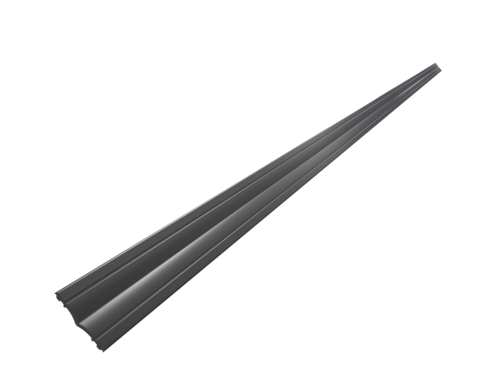
Rubber-and-metal boundary profiles are elastic bearing and guide elements that limit the movements of the bridge superstructure while simultaneously damping vibrations. By combining dimensionally stable metal with flexible, damping rubber, they allow for defined displacements, limit impermissible movements and safely transfer lateral forces. They protect the structure from overload and support a durable, low-maintenance bearing system.
Area of application
Rubber-to-metal bonded boundary profiles are used in road and railway bridges to limit movements of the superstructure and safely transfer lateral forces. They are used in particular at abutments and piers, where controlled displacement is permitted but impermissible structural movements must be prevented.
Technical details
Boundary profiles consist of an elastic rubber body combined with sturdy metal elements. This design allows for controlled restriction of bridge superstructure displacements while still permitting defined movements. The rubber component dampens vibrations and reduces stresses, while the metal components ensure force transmission and dimensional stability. This allows lateral forces to be reliably absorbed and prevents unwanted deformations, which provides long-term protection for the structure and stabilizes the bearing function.
Characteristics
Boundary profiles are characterized by high energy absorption capacity, robust lateral load transfer and defined movement limitation. They provide effective shock and vibration damping, maintain their shape under varying loads and exhibit high durability even under extreme temperature and load cycles. In addition, they require little maintenance, are resistant to aging and reliably protect the bridge structure from impermissible structural movements.