
Roof Articulation Joint in railway vehicles
A roof articulation joint is a vibration-damping component that is mounted on the car body of a railway vehicle and is designed to selectively dampen movements between individual sections of the car body or between the car body and the roof structure.
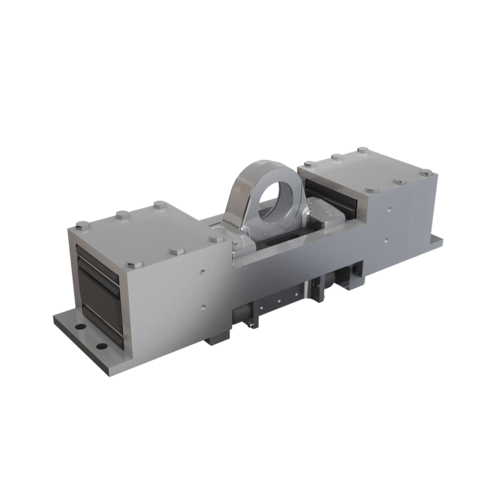
Area of application
Roof articulation joints are used in locomotives, multiple-unit trains, or railcars with modular roof systems - for example, where large roof-mounted components such as air conditioning units, pantographs, or ventilation units generate additional vibrations due to their mass. They are typically used where structural transitions, joints, or flexible roof segments are present that can be set into vibration by vehicle movements, wind loads, aerodynamic effects, or chassis excitations.
Technical details
The roof articulation joint system consists of two elastomer or rubber-metal dampers, a cross member, and the joint bracket. These dampers are designed to allow relative movement between the connected components while effectively reducing unwanted oscillations, vibrations and shock loads. This reduces the structural load on the car body and significantly extends the service life of the connected components. The primary functions of the roof articulation joint include vibration and structure-borne noise damping, which reliably absorbs vibrations caused by the undercarriage, vehicle operation, or aerodynamic forces. In addition, it compensates for relative movements, for example, between roof modules, roof hatches, or mounted units such as air conditioning units, ventilation ducts, or pantographs. At the same time, it protects the roof and car body structure by preventing high stresses at the mounting points, which could otherwise cause material fatigue or cracking. Furthermore, roof joint damping plays a crucial role in operational safety, as it ensures the proper functioning of roof-mounted systems even at high speeds, under severe vibrations, or when subjected to wind loads.
Characteristics
High-load-capacity rubber compounds are typically used in roof articulation joints in combination with robust metal supports. These elastic materials are characterized by high fatigue strength and temperature resistance, while also offering good resistance to weathering, UV radiation, and ozone. In addition, they have defined stiffness and damping values that enable precisely tuned vibration behavior. Their high material quality ensures that they achieve a long service life even under continuous dynamic loading. Roof articulation joints are primarily used in locomotives, multiple-unit trains, or railcars with modular roof systems. This is particularly true in areas where large roof-mounted components - such as air conditioning units, pantographs, or ventilation units - generate additional vibrations due to their weight and movement, thereby requiring effective damping.