
Measurement Technology
Rubber and metal damping elements are used in measurement and testing technology to protect sensitive sensors, test stands and measurement setups from vibrations, shocks and environmental influences. They provide reliable vibration isolation and stable mounting, thereby reducing interference and ensuring precise and reproducible measurement results.
Area of application
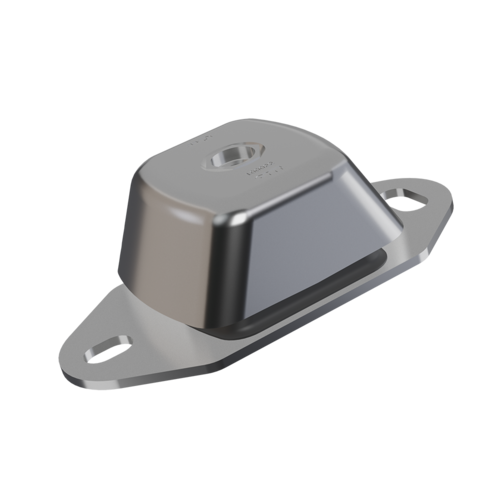
Rubber and metal damping elements are used in measurement and testing technology to reliably protect measurement and testing systems from vibrations, shocks and structure-borne noise. This minimizes external disturbances and improves the accuracy, repeatability and reliability of measurement results. Typical applications include test benches, sensor modules, calibration equipment, coordinate measuring machines, weighing systems and automated testing and inspection systems, as well as sensitive laboratory and mobile measurement setups. Technically, the elements consist of an elastic rubber component that is firmly bonded to metal inserts or housings. While the rubber absorbs and isolates vibrations, the metal ensures high load-bearing capacity, dimensionally stable mounting and precise force transmission. Hardness, damping characteristics, load capacity and geometry can be customized for specific applications. Key features include high damping effectiveness, defined stiffness, compact designs, maintenance-free operation and a long and reliable service life. The advantages include reduced measurement errors, improved signal quality and protection of sensitive components. This significantly increases process reliability, system service life and the quality of measurement results - a decisive factor for precision-critical applications in measurement and testing technology.
Technical details
In measurement technology, rubber and metal damping elements are used to protect sensitive sensors and precision measuring instruments from external vibrations and to ensure stable measurement results. Due to their viscoelastic behavior, rubber-based elements offer high internal damping and are particularly effective against high-frequency disturbances and for decoupling structure-borne noise. Metal damping components are characterized by high stiffness, dimensional stability and the ability to isolate low-frequency vibrations even under high loads; however, they exhibit only low inherent damping. For this reason, combined rubber-metal elements are frequently used; they ensure precise vibration reduction and long-term stability, which is crucial for accurate and reproducible measurements.
Characteristics
The most important properties of rubber and metal damping elements in measurement technology are precisely tuned stiffness, an appropriate degree of damping and a stable natural frequency to reliably isolate measurement systems from disturbances. Rubber is characterized by high internal damping, good vibration and noise absorption and electrical insulation; however, it is susceptible to aging and environmental influences. Metallic elements, on the other hand, offer high dimensional stability, load-bearing capacity and long-term consistency, but exhibit low inherent damping. When combined, both materials enable accurate, reproducible and long-term stable vibration decoupling, which is crucial for precise measurement results.