
Ball Joint
Rubber and metal ball joints, as elastic connecting elements, are used in mechanical and plant engineering as well as in industrial technology to enable multidimensional movements between components. They allow forces to be transmitted while simultaneously compensating for angular, axial and misalignment errors. Typical applications include articulated joints, linkages, actuating mechanisms and moving machine assemblies.
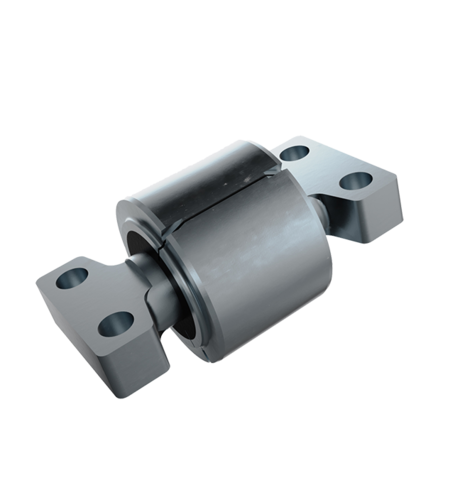
Area of application
Ball joints, as flexible connecting elements, consist of an inner spherical metal component, an outer shell and a vulcanized elastomer body. This design allows for three-dimensional movement while ensuring reliable force transmission. They are used in mechanical and plant engineering in linkages, lever mechanisms and control mechanisms where angular and alignment errors must be compensated for. In industrial engineering, ball joints are used in movable assemblies and articulated connections with varying directions of motion.
Technical details
Ball joints, as elastic connecting elements, are characterized by their three-axis mobility combined with defined force transmission capabilities. Technically relevant factors include high tilt angles, radial and axial load-carrying capacity and the ability to accommodate misalignment and angular errors without additional forces. Ball joints, as elastic connecting elements, consist of an inner spherical metal component, an outer shell and a vulcanized elastomer body. They are designed for continuous dynamic loading, low wear and precise performance characteristics.
Characteristics
Ball joints, as flexible connecting elements, are characterized by their high mobility in all directions while ensuring reliable force transmission. They enable low-stress compensation of angular, axial and misalignment errors without generating additional stress on components. They are characterized by precise specifications in various spatial directions as well as low wear during dynamic movements. Depending on the design, they also offer maintenance-free operation, low noise and a long service life in industrial applications.