
Elastomer Bearings
Elastomer mounts are used in mechanical and plant engineering, as well as in industry, as elastic mounting elements to reduce vibrations, shocks and structure-borne noise. They are made of heavy-duty elastomers that absorb forces while simultaneously compensating for movements and misalignments. Typical applications include the mounting of machines, units, motors, scales and industrial equipment to increase service life and operational reliability.
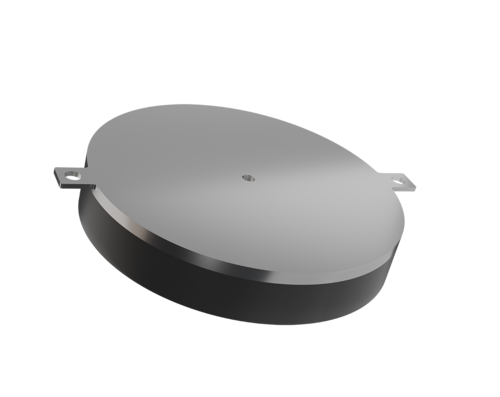
Area of application
Elastomeric mounts are used primarily in engine, transmission and power unit mountings to effectively reduce vibrations and noise. In mechanical and plant engineering, they are used in production, packaging, and conveyor systems where dynamic loads and misalignments must be compensated for. In industrial engineering, they are ideal for pumps, compressors, fans, scales and test benches that require smooth and stable mounting. In addition, elastomeric mounts are frequently used for foundation and frame decoupling in industrial and building structures.
Technical details
Elastomer mounts consist primarily of vulcanized elastomers (e.g., natural or synthetic rubber), often combined with metal inserts or mounting plates to ensure reliable load transfer. The elastomer body provides vibration, shock and noise damping, while the metal parts ensure dimensional stability and secure fastening. Technically, elastomeric bearings are characterized by defined axial and radial stiffnesses, nonlinear spring characteristics and the compensation of misalignment and angular errors. The material composition, hardness and geometry allow for application-specific design tailored to different load, frequency and environmental conditions.
Characteristics
Elastomer mounts exhibit material-dependent damping characteristics that can be specifically designed to reduce vibration in certain frequency ranges. They have defined tensile, compressive and shear stiffnesses, enabling them to safely absorb combined loads. A key characteristic is their hysteretic damping properties, in which vibration energy is converted directly into heat within the elastomer. In addition, elastomeric bearings are designed for long-term stability under continuous cyclic loading, as well as resistance to aging and chemical exposure.