
Buffer for soil compactors
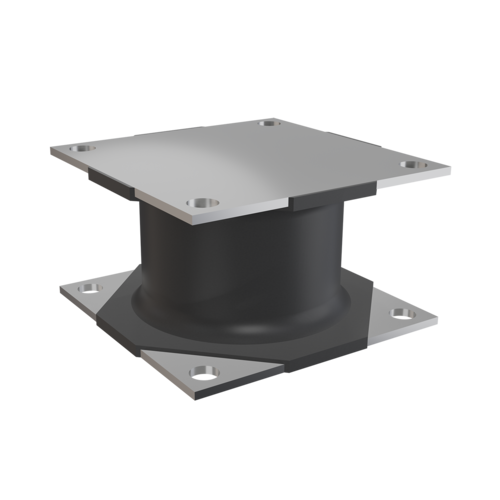
Buffers on soil compaction equipment are elastic rubber-metal components positioned between the drive system and the base plate of a vibratory plate. They serve to control the vibrational energy generated by the exciter so that the machine achieves a stable, directed and repeatable compaction effect.
Area of application
In soil compaction equipment - particularly in attachments - rubber-metal buffers are used to specifically transmit the vibrations generated by the vibrator to the base plate. They support the function of the vibration system by controlling the range of motion and directing the vibration in the desired direction. Typical applications include vibratory plates and attachments for compacting soil, sand, gravel or base courses.
Technical details
The buffers for soil compactors consist of an elastomeric rubber body with permanently attached metal parts. Their spring characteristics result from their geometry, Shore hardness and installation orientation. In vibratory plates and attachments, they transmit vibrations to the base plate, limit the working stroke and ensure stable, repeatable motion. Since high temperatures occur during operation, the rubber compounds must be temperature-resistant and reliably retain their elastic properties even under continuous stress.
Characteristics
Buffers on soil compaction equipment are compact, durable and designed to withstand high dynamic forces. They offer stable elastic characteristics and are available in various degrees of hardness and dimensions. The composite system of rubber and metal ensures reliable force transmission over long service life.
Their typical characteristics include high dimensional stability under continuous load, reproducible vibration behavior, a robust design capable of withstanding strong excitation forces and a reliable operating stroke even under varying loads.