
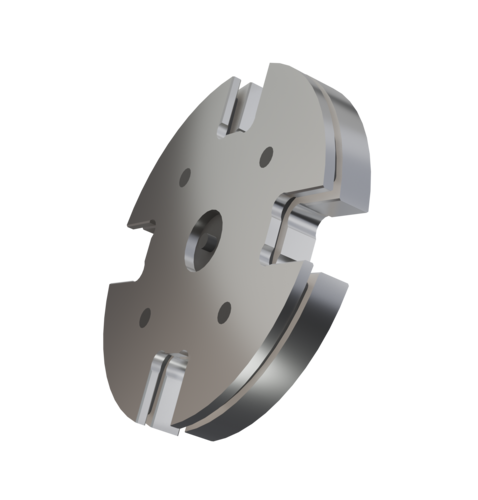
Drive plate
Rubber and metal drive discs are flexible coupling elements used in the powertrain of commercial vehicles to transmit torque between the engine, transmission and auxiliary drives in a flexible and low-vibration manner. They consist of a metal carrier supplemented by a flexible rubber body. Thanks to this combination, drive discs can not only reliably transmit torque and forces, but also dampen vibrations, absorb torque peaks and compensate for minor misalignments in the drivetrain.
Area of application
Rubber and metal drive discs are used in commercial vehicles wherever torque needs to be transmitted in a flexible and low-vibration manner. They are used in particular in the areas between the engine and transmission, the transmission and propeller shaft, as well as in auxiliary drives such as hydraulic pumps, compressors or auxiliary units. Thanks to their flexible rubber body, they dampen torsional vibrations, reduce load spikes during start-up or gear shifting, and prevent sudden loads from acting directly on the drivetrain. At the same time, they compensate for misalignment and minor offsets in shaft geometry, which significantly extends the service life of bearings, drive shafts and transmission components. In the clutch and connection systems of attachments, drive discs also ensure decoupled, material-friendly power transmission - especially under high loads or in challenging terrain.
Technical details
Rubber and metal drive discs consist of metal support elements supplemented by a vulcanized rubber body. This combination enables reliable torque transmission while providing high damping performance. The elastic rubber body absorbs torsional vibrations, compensates for misalignments between drive components, and reduces load peaks that occur during startup, shifting or under varying operating conditions. Support elements ensure secure attachment to the engine, transmission or auxiliary units and guarantee precise power transmission. Technically, drive-along discs are characterized by high torsional elasticity, defined spring and damping characteristics and high fatigue strength. They are resistant to dirt, moisture and extreme temperature fluctuations, enabling them to operate reliably even under severe operating conditions.
Characteristics
Rubber and metal coupling discs combine high torsional elasticity with robust metallic power transmission. This allows them to flexibly transmit torque while effectively dampening oscillations, vibrations and torque spikes. Their elastic rubber body ensures that misalignments, offsets and minor angular deviations between the motor, gearbox and drive shafts are compensated for without transferring additional loads to bearings or joints. They exhibit defined deformation characteristics that cushion harsh load cycles and ensure a uniform flow of force. At the same time, they are highly fatigue-resistant and retain their functional properties even under continuous load. Thanks to this combination of elasticity, damping and structural stability, drive-along discs play a crucial role in relieving stress on the drivetrain, extending the service life of adjacent components and reducing operating noise levels.