
Compound spring
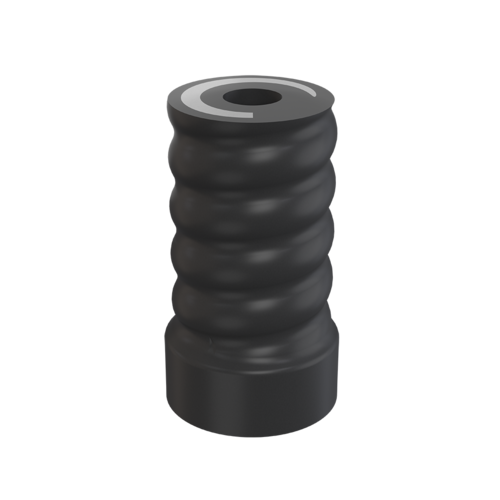
Composite springs, consisting of rubber-metal assemblies, are elastic elements that absorb mechanical loads and return them in a controlled manner. The combination of different geometries and materials results in a defined spring response that can enable both linear and progressive characteristic curves. Composite springs are used when high dynamic loads, repeated load cycles or targeted vibration isolation or excitation are required.
Area of application
In the field of vibration generation - for example, in vibrating screens - compound or composite springs serve to convert the oscillating motion of the drive into a stable and reproducible working motion of the machine. They ensure a defined direction of motion and contribute significantly to generating the desired amplitude and frequency. Due to their design, composite springs are particularly well-suited for applications involving high stroke rates and continuous alternating loads, such as those found in mineral processing, conveying and screening processes or in machines that operate cyclically.
Technical details
Technically, compound springs consist of a rigid connection between steel spring elements and an elastic rubber component. Compound springs offer high fatigue strength under cyclic loading. To ensure that the vibrational energy is converted into useful motion as efficiently as possible, a rubber compound is used that exhibits only minimal hysteresis losses and thus minimal heat generation within the material. At the same time, care must be taken to ensure that the stress on the elastomer does not become too high, in order to prevent premature heating and the resulting fatigue during continuous operation. A carefully coordinated design of geometry, material and load contributes significantly to the service life and operational reliability of the compound spring.
Characteristics
Compound springs offer high fatigue strength under cyclic loading, precise motion control without play and directional stiffness (soft in the direction of action, stiff in transverse axes to ensure stability). They enable reproducible amplitudes, low maintenance requirements and compact installation conditions. The inherently low damping ratio supports efficient energy transfer from the exciter to the desired vibration. In practical applications, the focus is on generating defined vibrations and reliably transmitting them to the respective system.