
Wedge Bearings for vibration damping in railway vehicles
Wedge bearings are high-performance rubber-metal bearing elements used to mount and suspend equipment such as engines, transmissions, and compressors.
Area of application
Motor and power unit mounts, designed as wedge mounts, are used in the railway vehicle primarily in applications where high vertical compressive forces, vibration damping and limited travel are required. Their wedge-shaped elastomer elements provide particularly stable support under high loads and limit compression as well as extension movements, making them ideal for vibration- and shock-prone assemblies such as drive units, auxiliary systems or mounting points in the bogie. Thanks to their compact design and ability to absorb forces in all directions they are also suitable for tight installation spaces and applications with high safety requirements.
Technical details
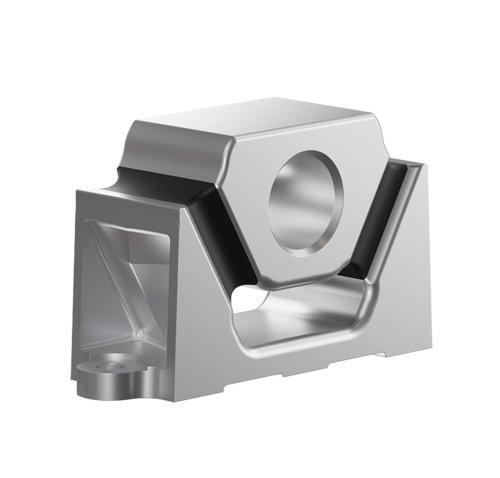
Wedge bearings consist of an outer omega-shaped metal bracket with a flange and an inner metal component with threaded holes. V-shaped elastomer elements are vulcanized between these two metal parts, creating the characteristic wedge effect. They feature travel limits in all spatial directions with deflection in the Z-direction being supported. Intermediate plates can nearly double the Z-stiffness while maintaining the same installation space; an integrated “soft end stop” limits the maximum deflection. These properties make wedge bearings particularly resistant to vertical compressive loads and suitable for applications with high vibration levels.
Characteristics
Compared to conventional elastomer bearings wedge bearings offer particularly high dimensional and functional stability, as their metallic wedge structure precisely guides the elastomer, thereby enabling reliable force absorption. The defined wedge angle allows the stiffness to be tailored very precisely to the specific application. In addition, wedge bearings exhibit minimal settlement under continuous load, which enhances their long-term stability. Their robust design can also compensate for moderate installation tolerances without significantly impairing bearing function.