
Support Spring: support of coupling units in railway vehicles
Support springs in car body couplings are used to provide elastic support for the coupling unit and to allow controlled movement between two permanently connected car bodies. They help the coupling absorb vertical and horizontal relative movements, compensate for chassis movements such as pitching or yawing and ensure stable power transmission without transferring sudden, high loads to the car body structure. In this way, they contribute significantly to smooth running, coupling stability and reduced wear in the articulation area.
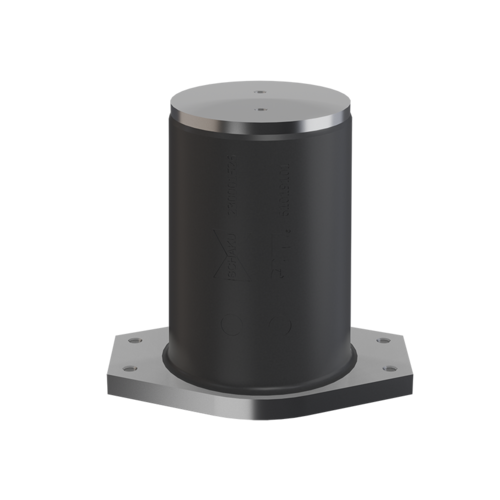
Area of application
Support springs are used wherever car-body couplings must permanently connect two car bodies in an articulated manner while also safely absorbing relative movements. They are used in particular in articulated and multi-unit vehicles such as multiple-unit trains, light rail vehicles, and streetcars.
Technical details
Support springs in car body couplings are designed to absorb vertical, lateral and torsional movements simultaneously; due to the limited installation space in the articulation area, they are constructed as short-stroke, highly progressive spring assemblies. They feature multi-stage stiffness zones that smoothly dampen small relative movements and absorb load peaks significantly more firmly when cornering or braking. In addition, they provide vibration isolation by being tuned to a specific natural frequency and perform a centering return function so that the car bodies realign to their neutral position during normal operation. Support springs must be both temperature- and age-stable and exhibit minimal tendency to settle, as they operate in the heavily loaded coupling area. The support spring typically consists of two metal plates and an elastomer body with specified characteristics.
Characteristics
Support springs in car body couplings provide a particularly uniform spring action that remains stable even under severe load cycles and reliably relieves stress at the coupling point. Their design allows them to smoothly absorb small movements without stiffening the structure, while at the same time offering exceptional cycle resistance and maintaining their properties virtually unchanged over a long period of time. As a result, they contribute significantly to consistently stable and low-wear coupling performance.