
Breakaway Protection / Decoupling Element /Fastener
Rubber-to-metal bonded fasteners, breakaway protection and decoupling elements are used in the car bodies of railway vehicles to support the floors and secure the walls as well as to mount various components - such as air conditioning and ventilation units, battery boxes and inverters - to the vehicle with minimal vibration and in a way that protects the structure.
Area of application
Rubber-to-metal bonded fasteners, breakaway protection and decoupling elements are used in the vehicle body primarily in areas where modules, power units, housings, and technical assemblies must be securely attached to the structure in order to reduce the transmission of vibrations or noise into the passenger compartment and to ensure a flexible mounting. Wherever operational vibrations, harsh impacts or dynamic loads occur, these elements ensure that the vehicle body structure is protected and the service life of the components and systems inside the car body is extended.
Technical details
Fastening elements, breakaway protection and decoupling elements for installation inside the vehicle body consist of vulcanized rubber-metal assemblies; the elastomer body can be designed to provide defined multi-axial stiffness. Through conical or multilayer elastomer structures, integrated preload, and progressive characteristic curves, they can specifically absorb dynamic loads, vibrations and structure-borne noise. Precisely molded elastomer zones ensure optimized frequency and damping behavior, while mechanical stops or deflection limiters ensure component protection under extreme loads. High-strength rubber compounds and corrosion-protected metal parts ensure long-term durability. For reasons of durability and the contribution to the overall weight, the carrier materials are sometimes made of aluminum.
Characteristics
Thanks to the firmly vulcanized bond between the metal and the elastomer, these components can effectively dampen vibrations, structure-borne noise and impacts while elastically absorbing movements, misalignment and dynamic loads caused by vehicle operation. By selecting durable materials such as synthetic rubber and aluminum, they can be designed for a long service life. Their high elasticity, temperature resistance and resistance to aging make them suitable components for the structural design of car bodies.
Variants
Breakaway protection
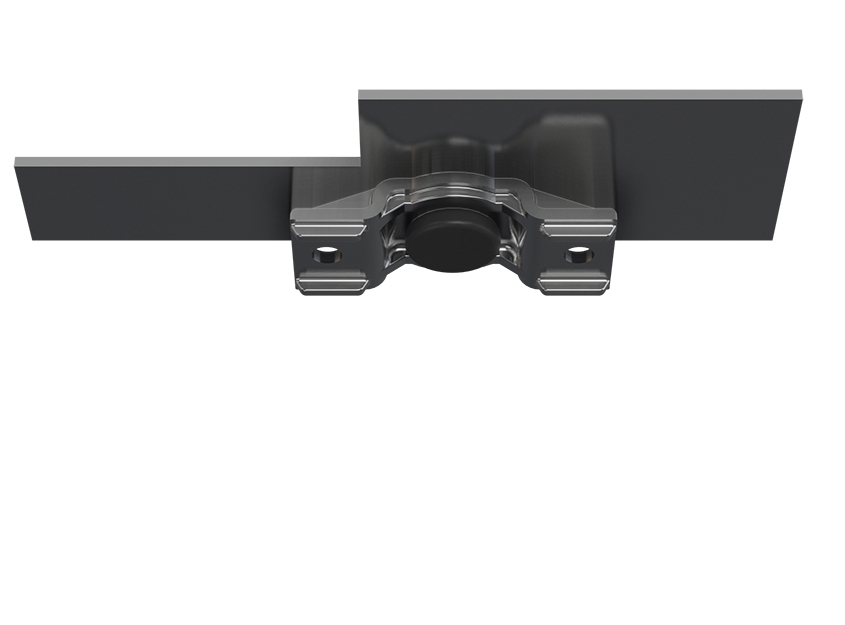
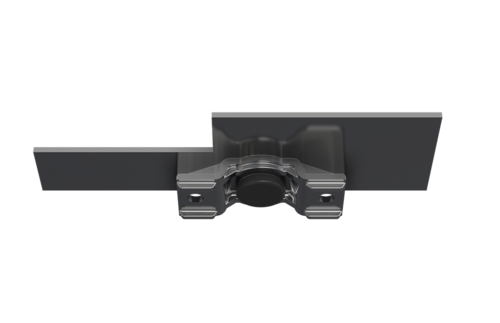
Rubber-to-metal bonded breakaway protection in the interior of a railway vehicle are used to provide a flexible, safety-critical mounting for components installed beneath the vehicle floor - such as cable trays, trim elements or technical service modules. The mounts combine a flexible rubber body with a form-fit metal part, ensuring that these components are vibration-decoupled during normal operation but are reliably held in place in the event of an overload. The elastomer component effectively reduces vibrations, structure-borne noise and minor impacts caused by operational dynamics, bogie movements or rail noise. This minimizes noise levels inside the passenger compartment and extends the service life of the mounted components. At the same time, the integrated mechanical lock ensures that the fastening is prevented from being torn out under exceptional loads - such as strong vertical impacts, emergency braking or abrupt relative movements. Since these breakaway protection or anti-tear-out devices are installed inside the passenger compartment beneath the floor, they must be compact, durable and low-maintenance. They are designed for high fatigue strength, resistance to aging and temperature tolerance and meet the technical requirements for fire protection, vibration isolation and structural integrity within the car body. As a result, rubber-metal anti-tear devices make an important contribution to operational safety, noise optimization and structural stability in modern railway vehicles.
Floor Mounting | Decoupling Element
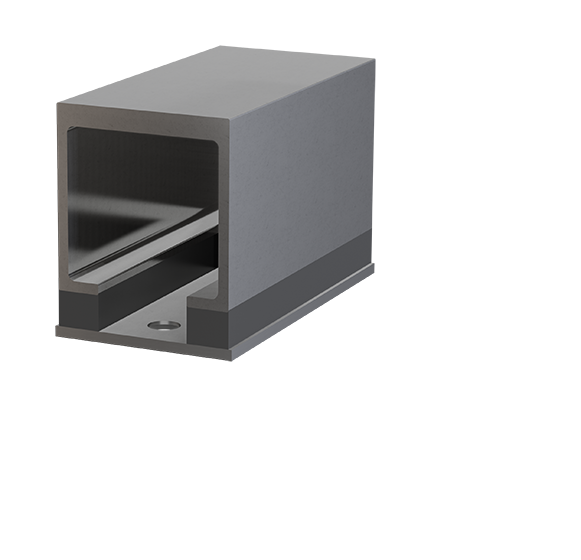
The floor mounting or decoupling element inside a railway vehicle is designed to provide a flexible, low-vibration and structurally secure attachment of the floor modules to the car body. Typically, rubber-metal elements or elastic mounting assemblies are used for this purpose; they filter vibrations, reduce structure-borne noise and compensate for relative movements between the vehicle structure and the floor panel. This mounting system plays a crucial role in acoustic optimization, comfort and stability within the passenger compartment. Technically, the floor mounting system - or decoupling element - consists of an elastomer body vulcanized between two metal parts, providing defined stiffness in both the vertical and horizontal directions. This reliably dampens vibrations caused by suspension movements, track irregularities or powertrain operation without compromising the structural connection. The elastic mounting absorbs small movements, prevents material fatigue in the floor elements and protects adjacent components such as cable routing, trim or service modules. Since the mounts are installed in an enclosed space beneath the floor, they must meet high requirements for fatigue strength, fire resistance, temperature resistance and resistance to aging. At the same time, they provide a stable, low-maintenance mounting system that contributes to reduced noise levels, greater comfort and enhanced operational safety in the vehicle over the long term.