
Hollow spring in automatic couplers
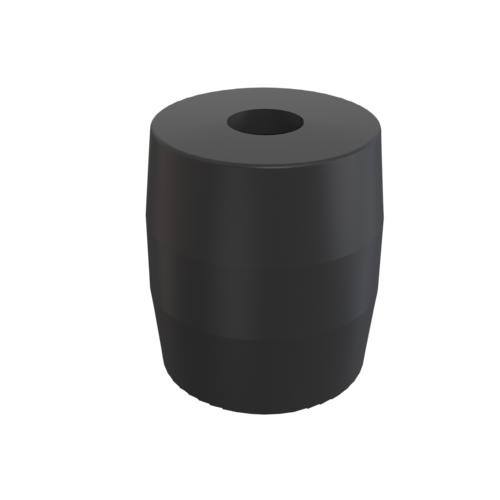
The rubber hollow spring is a key vibration and shock-absorbing component in automatic couplers. It offers high damping performance, multidirectional elasticity, a compact design and a long service life. As a result, it improves safety, comfor, and ease of maintenance throughout the entire coupler system.
Area of application
Rubber hollow springs perform important functions in the coupler assembly, providing vibration isolation, system decoupling and protection for sensitive components. Beneath automatic couplers, they act as vibration dampers between the coupler carrier and the vehicle frame, reducing vertical and horizontal vibrations and protecting surrounding assemblies. They dampen engagement shocks, filter out torsional movements and compensate for relative movements during cornering, contributing to a robust and durable coupler architecture.
Technical details
A hollow rubber spring in automatic couplings for railway vehicles serves as an elastic spring-damper element to reduce vibrations and dynamic loads in the coupling area. The ring-shaped rubber body with an internal hollow chamber enables a defined, progressive spring characteristic curve: During small movements, the spring operates softly and dampens vibrations, while it responds with increasing stiffness under higher loads. As a result, both operational vibrations as well as impact and torsional forces during coupling or when negotiating curves are effectively absorbed. The rubber hollow spring decouples the coupling bracket from the vehicle structure, protects adjacent components and allows for low-maintenance relative movements without metallic joints.
Characteristics
The use of a rubber hollow spring in automatic couplings for railway vehicles offers significant advantages for low-vibration and reliable operation. Thanks to its elastomeric design, it effectively reduces vertical, horizontal and torsional vibrations and decouples the coupling mechanism from the vehicle frame. This reduces noise while also protecting adjacent components - such as the coupling head, power and data couplings and guide mechanisms - from unnecessary stress. The progressive spring characteristic ensures that small movements are smoothly damped, while significantly increased stiffness under high forces - such as during coupling - contributes to safe force absorption. Its robust, virtually wear-free design without metallic friction points makes the rubber hollow spring particularly low-maintenance and resistant to dirt, moisture and temperature fluctuations. At the same time, it allows for defined relative movements between the coupling and the vehicle structure, which safely compensates for suspension movements and cornering. Thanks to its flexibly adaptable geometry, it can be easily integrated into various coupling systems and offers a favorable ratio between installation space and power consumption.