
Shear spring
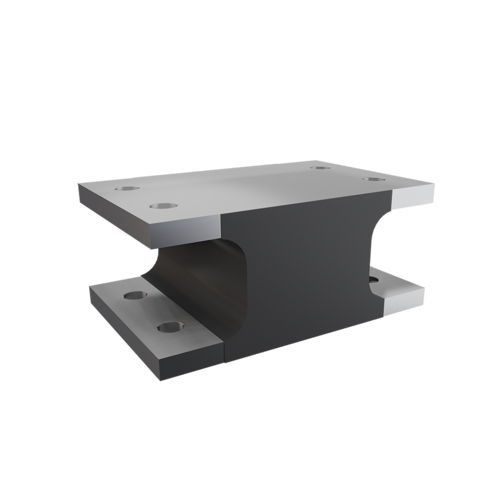
Shear springs can be made of rubber or a combination of rubber and metal. They are used to absorb and transmit shear forces and are frequently employed in applications where components must be shifted relative to one another or where movements need to be absorbed. The main function of shear elements is to control relative movements in the shear direction, transmit forces and simultaneously reduce vibrations, shocks and noise.
Area of application
Shear springs are used in technical systems and machines where thrust forces, relative displacements and dynamic loads occur between components. Typical areas of application include mechanical and plant engineering and equipment manufacturing as well as load-bearing and mounted structures. They are used wherever components must be mounted so that they can slide relative to one another, while at the same time requiring elastic force transmission and effective vibration isolation. Due to their ability to absorb shear, compressive and alternating dynamic forces, shear elements are particularly well-suited for applications involving periodic movements, vibrations or shock loads. In such applications, they help reduce wear and minimize load peaks that can occur with rigid mountings.
Technical details
Shear springs generally absorb and transmit loads in the shear direction. The spring behavior of a shear element is largely determined by the elastomer. By carefully selecting the rubber compound, the force-displacement curve - and thus the stiffness and rebound behavior - can be tailored to the specific application. The result is precisely tailored rubber and rubber-to-metal solutions that reliably transmit forces while effectively reducing dynamic loads.
Characteristics
Shear springs are characterized by a balanced combination of elasticity and mechanical stability. They effectively reduce vibrations and noise, contributing to quiet and gentle operation of the equipment. By selecting the appropriate materials, requirements regarding the temperature range and resistance to aging can be met. This ensures reliable operation even under demanding industrial conditions.