
Engine Mount
Engine mounts are elastic mounting components designed to mount engines in machines, vehicles or powertrain systems in a vibration-isolated manner. They connect the engine to the frame and reduce the transmission of vibrations, shocks and structure-borne noise, while ensuring reliable force and power transmission. The mounts safely absorb the engine’s weight as well as static and dynamic loads resulting from operation, acceleration, braking and varying torques and transfer these loads to the supporting structure.
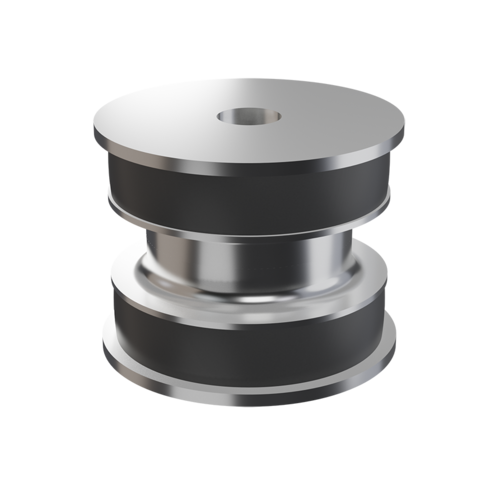
Area of application
Engine or motor mounts are used in a wide variety of technical systems - for example, in commercial vehicles, mobile machinery, industrial trucks, generator sets, pump systems, construction and agricultural machinery and stationary industrial units. Wherever a motor generates vibrations, torque or dynamic loads, engine mounts ensure that these forces are not transmitted undamped to the chassis or machine frame. They protect adjacent components, improve operating comfort and reduce noise.
Technical details
During operation, engine mounts are subjected to both static loads from the engine’s weight and dynamic forces resulting from acceleration, braking and load-change processes. In addition, they must absorb the torques and reaction torques generated by the engine and transfer them in a controlled manner to the surrounding structure. By specifically tuning the elastic properties in different load directions, engine mounts allow for a defined degree of engine mobility while ensuring safe force and torque transmission. This limits unwanted relative movements without compromising vibration isolation. Through the combination of metallic structural elements and elastic damping components, engine mounts enable smooth, stable and long-lasting operation of the powertrain.
Characteristics
The engine mount enables the simultaneous absorption and transmission of static and dynamic loads that occur during operation - including the motor’s weight, drive forces and torques - to the surrounding structure. Due to the elastic properties of the elastomer, these loads are not rigidly transmitted but are instead isolated from vibrations. This effectively reduces the transmission of vibrations, shocks and structure-borne noise to adjacent components, while maintaining the necessary power and force transmission.